
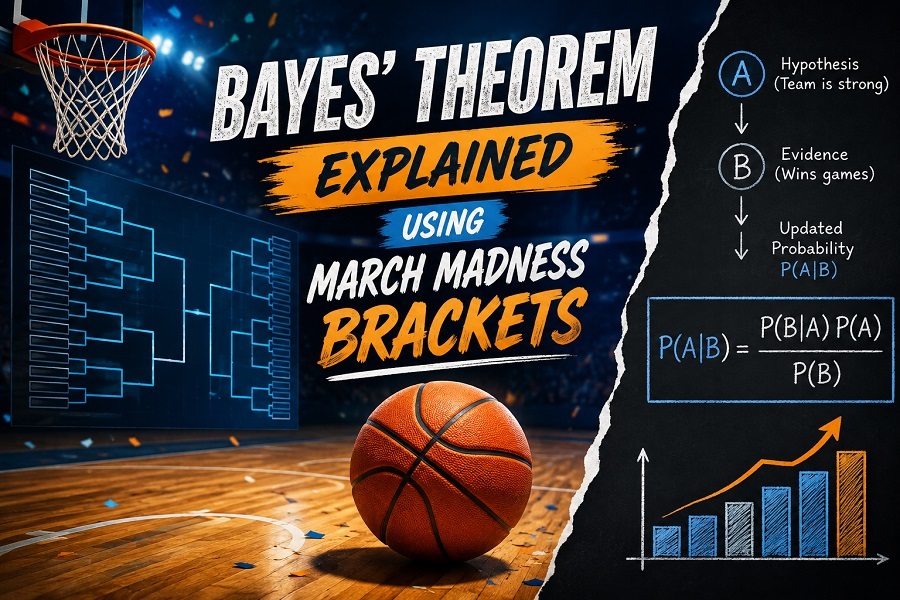
Introduction: Why March Madness Is the Perfect Bayes’ Theorem Analogy
Every March, millions of Americans fill out NCAA tournament brackets, watch upsets unfold, and update their predictions in real time as scores come in. What most bracket-fillers don’t realize is that they’re doing something mathematicians have a formal name for: Bayesian updating.
If you’re an IB Maths student (AA or AI, SL or HL) struggling to make sense of Bayes’ Theorem, March Madness offers one of the most intuitive, US-relevant ways to finally “get it.” At IB Maths Tutor, a trusted IB Maths Tutor in USA, we’ve found that connecting abstract probability formulas to something students already care about — like predicting who wins the Final Four — makes the concept stick far better than a textbook example ever could.
This blog breaks down Bayes’ Theorem step-by-step, using real bracket logic, so you can walk into your next IB Math exam (or IA) with genuine conceptual clarity, not just memorized formulas.
What Is Bayes’ Theorem? A Quick Refresher
In the IB Mathematics syllabus (both AA and AI), Bayes’ Theorem appears under probability, typically expressed as:
P(A|B) = [P(B|A) × P(A)] / P(B)
In plain English, this tells you: given that event B has happened, what’s the updated probability that event A is true?
The core idea is simple once you strip away the notation: new evidence should change your beliefs. You start with an initial estimate (called the prior probability), new information comes in, and you update to a more accurate estimate (the posterior probability).
This is exactly what happens every single year during the NCAA basketball tournament.
Setting the Scene: Filling Out Your Bracket
When you fill out a March Madness bracket before Round 1 tips off, you’re making predictions based on prior probability — everything you know before any games are played. This includes:
- A team’s regular-season record
- Their seed (1 through 16)
- Strength of schedule
- Key injuries
- Historical tournament performance
Statistically, a 1-seed has historically won its first-round game against a 16-seed in the vast majority of matchups (16-seeds have won only once in tournament history, in 2018). So before tip-off, your prior belief might be:
P(1-seed wins Round 1) ≈ 0.99
That’s your starting point — your prior. Now the game begins, and this is where Bayes’ Theorem takes over.
Updating Beliefs: The Bayesian Moment
Let’s say the 1-seed trails at halftime, something rare but not impossible. Should your prediction for the final outcome stay exactly the same as it was pre-game? Of course not — new evidence has entered the picture.
This is precisely what Bayes’ Theorem formalizes:
- A = “The 1-seed wins the game”
- B = “The 1-seed is losing at halftime”
You want to know P(A|B) — the probability the 1-seed still wins, given that they’re behind at the half.
To calculate this, you need:
- P(A) — the prior probability the 1-seed wins overall (based on season data)
- P(B|A) — the probability of trailing at halftime given that they go on to win (this happens sometimes, even for strong teams)
- P(B) — the overall probability of any team trailing at halftime, across all games
Plugging these into the formula gives an updated, more realistic probability that accounts for the new evidence, rather than blindly sticking with the pre-game estimate.
This is the heart of Bayesian thinking: your beliefs should shift in proportion to how surprising the new evidence is.
Why This Matters for IB Maths Students
IB examiners, particularly in Applications and Interpretation (AI), love real-world contextualized probability questions. Understanding Bayes’ Theorem through brackets helps with:
1. Internal Assessments (IAs)
Sports analytics is a goldmine for IB Math IAs. Using real NCAA tournament data to model upset probabilities or test Bayesian predictions against actual outcomes is a topic that’s both original and data-rich — exactly what IB moderators reward with high marks for personal engagement and mathematical exploration.
2. Paper 2 and Paper 3 Exam Questions
Conditional probability questions frequently appear in exam papers dressed up in real-world scenarios: medical testing, weighted dice, or sports outcomes. Once you understand the logic of updating probabilities (not just the formula), these questions become far less intimidating.
3. Building Genuine Statistical Intuition
US colleges — especially for STEM, economics, data science, and business programs — value students who can reason probabilistically, not just calculate. Bayesian thinking is foundational in fields like machine learning, finance, and public health, all popular destinations for IB graduates applying to US universities.
A Worked Example: Upset Probability
Let’s make this concrete with simplified numbers (illustrative, not official NCAA statistics):
Suppose:
- P(Upset) = 0.15 (15% of first-round games are upsets, historically)
- P(Underdog leads at halftime | Upset happens) = 0.70
- P(Underdog leads at halftime) = 0.25 (across all games, upset or not)
We want: P(Upset | Underdog leads at halftime)
Using Bayes’ Theorem:
P(Upset | Leads at half) = (0.70 × 0.15) / 0.25 = 0.105 / 0.25 = 0.42
So even though upsets only happen 15% of the time overall, once you know the underdog is leading at halftime, the probability of an eventual upset jumps to 42%. That’s the power of Bayesian updating — a single piece of evidence dramatically reshapes your prediction.
This exact structure — prior, likelihood, evidence, posterior — is what IB examiners expect students to identify and apply correctly on exam papers.
Common Mistakes IB Students Make with Bayes’ Theorem
Through years of tutoring US-based IB students, the team at IB Maths Tutor consistently sees the same errors:
- Confusing P(A|B) with P(B|A) — these are not the same thing, and mixing them up is one of the most common IB exam errors.
- Forgetting to calculate P(B) correctly using the law of total probability when it’s not given directly.
- Treating Bayes’ Theorem as a memorized formula rather than understanding the “update your belief with new evidence” logic — which is exactly why real-world analogies like brackets are so effective.
- Rushing the tree diagram — for IB exams, drawing a probability tree before applying Bayes’ Theorem prevents nearly all careless errors.
How IB Maths Tutor Helps US Students Master Probability
As a dedicated IB Maths Tutor in USA, our approach at IB Maths Tutor is built around making abstract IB Math concepts click through context students already understand — sports, technology, finance, and everyday American life. Our tutors specialize in:
- One-on-one IB Math AA and AI tutoring (SL & HL) for US-based students
- IA topic selection and full IA support, including sports and data-analytics-based explorations
- Exam-focused strategy for Paper 1, 2, and 3
- Bridging IB Math concepts with US college admissions requirements (AP correlations, credit policies, and STEM readiness)
Whether you’re prepping for a probability-heavy Paper 2 question or looking for a standout IA topic rooted in real data (like NCAA tournament outcomes), our tutors help translate theory into genuine understanding.
Frequently Asked Questions (FAQ)
Q: Is Bayes’ Theorem tested in both IB Math AA and AI? A: Yes. Conditional probability, including Bayes’ Theorem, appears in both course syllabi, though AI tends to frame it in more applied, real-world contexts.
Q: Can I use March Madness data for my IB Math IA? A: Absolutely. Publicly available NCAA statistics make for a strong, original IA topic, especially when testing Bayesian predictions against actual tournament results.
Q: What’s the easiest way to remember the difference between prior and posterior probability? A: Prior = what you believed before new evidence. Posterior = what you believe after new evidence. March Madness brackets before tip-off vs. after halftime is a perfect real-world example.
Q: Does IB Math cover conditional probability trees? A: Yes, probability trees are a core tool in the syllabus and are highly recommended for organizing Bayes’ Theorem problems before calculating.
Bayes’ Theorem doesn’t have to be an intimidating wall of symbols. Once you connect it to something as familiar as a March Madness bracket, the logic becomes intuitive: start with what you know, update as new evidence arrives, and arrive at a smarter prediction.
If you’re a US-based IB student looking to strengthen your probability skills, tackle a standout IA, or simply want a tutor who explains math in a way that actually makes sense, reach out to IB Maths Tutor — your dedicated IB Maths Tutor in USA for AA and AI, SL and HL, coast to coast.