
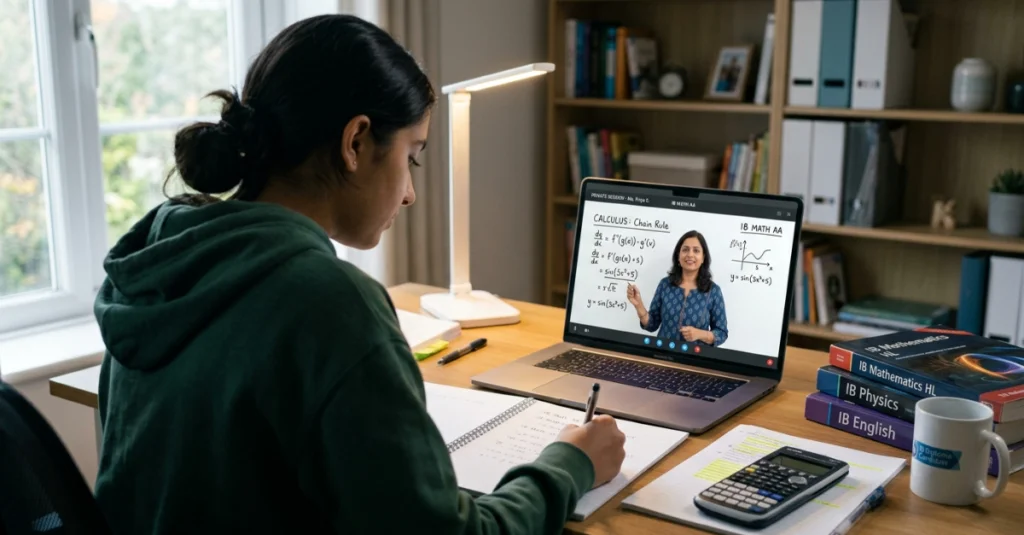
Finding the right online IB Maths tutor can make the difference between a grade 4 and a grade 7. With so many tutoring platforms and freelance tutors now operating across England, parents and students need a clear framework for evaluating quality — not just price or availability.
Here’s what actually matters when choosing an online IB Maths tutor in England.
1. IB-Specific Qualification and Experience
Not all maths tutors understand the IB. A-Level and GCSE maths tutors often struggle with IB’s unique structure — the Analysis & Approaches (AA) vs Applications & Interpretation (AI) split, the Internal Assessment, and the IB’s emphasis on mathematical reasoning over rote calculation.
Look for a tutor who:
- Has taught the current IB Maths syllabus (post-2019 curriculum)
- Understands the difference between SL and HL demands
- Ideally has IB examiner or moderator experience, or has taught at an IB World School
Why this matters: A tutor without direct IB experience may teach maths correctly but miss the specific command terms, assessment criteria, and mark-scheme language the IB uses — which directly affects exam performance.
2. Proven Track Record with England-Based IB Students
England has a growing number of IB World Schools, and each has slightly different pacing, resources, and internal deadlines. A tutor who has worked with students from schools in England understands:
- Typical IA submission timelines
- Common gaps between school teaching and exam expectations
- How UK university offers (via UCAS) interpret IB grades for entry requirements
This local context is often overlooked but genuinely shapes how effective a tutoring relationship is.
3. Ability to Support the Internal Assessment (IA)
The IA is where most IB Maths students lose confidence — and marks. A strong tutor should be able to:
- Help refine a mathematical exploration topic that’s neither too broad nor too narrow
- Guide (not write) the mathematical process, keeping the work authentically the student’s own
- Explain the assessment criteria (Criteria A–E) in plain terms
- Spot common errors examiners penalise, such as weak personal engagement or unjustified conclusions
If a tutor can’t clearly explain the IA marking criteria unprompted, that’s a red flag.
4. Structured Diagnostic Assessment Before Lessons Begin
Reputable tutors don’t just “start teaching” — they first assess:
- Current grade boundary position (e.g., is the student at a 4, 5, or 6?)
- Specific topic weaknesses (e.g., calculus, statistics, vectors)
- HL vs SL alignment issues, if the student is considering switching levels
A proper diagnostic ensures lessons are targeted rather than generic, which is especially important for expensive 1-to-1 online sessions.
5. Teaching Style Suited to Online Delivery
Online tutoring isn’t just in-person tutoring conducted over a webcam. Look for tutors who use:
- Interactive digital whiteboards (not just screen-sharing static slides)
- Real-time worked examples the student can follow and replicate
- Recorded sessions for revision (many England-based students revisit lessons before mocks and finals)
- Clear homework and feedback loops between sessions
Ask for a trial lesson — this reveals more about teaching quality than any testimonial.
6. Transparent Communication with Parents
For families in England managing school deadlines alongside tutoring, regular progress updates matter. Good tutors provide:
- Session summaries after each lesson
- Clear tracking against target grades
- Honest feedback if a student is off-pace — not just reassurance
7. Flexibility and Reliability
Online tutoring should reduce friction, not add it. Check:
- Time zone consistency (particularly relevant if tutors are based outside the UK)
- Rescheduling policies
- Platform reliability (video quality, whiteboard tools, file sharing)
8. Reviews and Verifiable Outcomes
Look past star ratings alone. Ask for:
- Specific grade improvement examples (e.g., “moved from a 4 to a 6 in two terms”)
- References from IB parents in England specifically, where possible
- Clarity on whether reviews are independently verified
Quick Checklist: Vetting an Online IB Maths Tutor
| What to Check | Why It Matters |
|---|---|
| IB curriculum experience | Avoids generic maths teaching that misses IB-specific demands |
| IA support capability | IA is a major, often mismanaged, part of the final grade |
| Diagnostic assessment offered | Ensures lessons target real gaps, not assumptions |
| Trial lesson available | Best way to judge teaching quality firsthand |
| Progress reporting | Keeps parents informed and students accountable |
At IB Maths Tutor, every online tutor is vetted specifically for IB Maths AA and AI experience, with many having direct examining or IB school teaching backgrounds — ensuring students in England get tutoring that’s aligned with exactly how the IB grades their work, not generic maths coaching.