
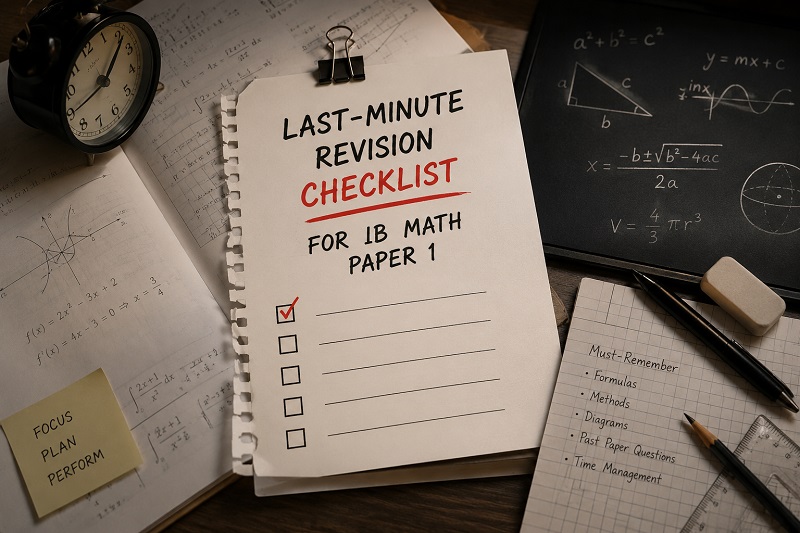
IB Math Paper 1 is the non-calculator paper for both Analysis and Approaches (AA) and Applications and Interpretation (AI), and it tests whether a student can work through algebra, functions, and core techniques by hand, without leaning on a GDC to check every step. In the final week before the exam, the goal isn’t to learn new content — it’s to consolidate what’s already there, close small gaps, and build exam-day speed. This checklist breaks that process into clear, actionable stages.
What Makes Paper 1 Different From Paper 2
Before diving into revision, it helps to understand what Paper 1 is actually testing.
Paper 1 is calculator-free, which means examiners design questions around techniques that can be done by hand: algebraic manipulation, differentiation and integration rules, trigonometric identities, and exact-value reasoning. Paper 2, by contrast, allows a GDC and often includes more applied, real-world context questions.
This distinction matters for revision because it changes how a student should practice. Reviewing worked examples on a screen is not the same as solving a problem with only a pen, paper, and formula booklet — under time pressure. Last-minute revision for Paper 1 should therefore prioritize handwritten practice over passive review.
Days 5–7 Before the Exam: Map the Syllabus Gaps
Identify Weak Topics Using Past Paper Data
The most efficient way to spend limited time is to revise strategically, not sequentially. Rather than starting from Topic 1 and working forward, a student should:
- Pull mark schemes from 2–3 recent past papers
- Mark which questions were answered incorrectly or skipped
- Group errors by topic (e.g., logarithms, sequences, differentiation rules)
- Rank topics by how frequently they cost marks
This creates a short, prioritized list — usually 3 to 5 topics — that deserves the bulk of remaining study time, rather than spreading effort evenly across the entire syllabus.
Separate “Knowledge Gaps” From “Careless Errors”
Not all lost marks come from not knowing the material. It’s worth sorting mistakes into two categories:
- Conceptual gaps — the method or formula wasn’t known or was misunderstood
- Execution errors — the method was correct, but a sign error, misread question, or arithmetic slip caused a lost mark
Conceptual gaps need targeted review of notes or textbook sections. Execution errors need slower, more careful practice under exam conditions — often the more common issue in the final week, and the easier one to fix quickly.
Days 3–4 Before the Exam: Rebuild Core Techniques by Hand
Recreate the Formula Booklet From Memory
Even though the IB provides a formula booklet in the exam, relying on it too heavily wastes time on exam day. A useful drill is to write out, from memory, the formulas for:
- Differentiation and integration rules
- The quadratic formula and discriminant conditions
- Trigonometric identities (double angle, Pythagorean)
- Arithmetic and geometric sequence/series formulas
- Log laws and exponent rules
Comparing this against the actual formula booklet highlights exactly which formulas are genuinely memorized versus which ones still require lookup — informing where extra flashcard-style repetition is needed.
Practice Algebraic Manipulation Without a Calculator
A large share of Paper 1 marks come not from advanced concepts but from clean algebra: factoring, simplifying surds, rationalizing denominators, and solving equations exactly (in fraction or root form, not decimals). Timed, no-calculator drills on:
- Simplifying expressions with indices and surds
- Solving quadratic, exponential, and logarithmic equations exactly
- Manipulating trigonometric equations within a given domain
…tend to produce faster mark gains than reviewing new theory this close to the exam.
Redo Mistakes From Earlier Practice Papers
Rather than attempting entirely new papers, it’s often more effective to redo questions previously answered incorrectly. This tests whether the underlying gap has actually closed, rather than just the answer being remembered.
Days 1–2 Before the Exam: Simulate Exam Conditions
Complete One Full Timed Paper 1 Under Real Conditions
With one or two days left, a full past paper attempt — timed, no calculator, no notes — closely simulating the real exam is valuable. This should include:
- Using only the permitted formula booklet
- Sticking to the actual time limit (typically 90 minutes for SL, 120 minutes for HL)
- Writing full working, not just final answers, since IB Math grades method as well as accuracy
Review Using the Official Mark Scheme, Not Just the Final Answer
After finishing, marking against the official scheme — not just checking whether the final number matches — reveals a lot. IB mark schemes award marks for method (M marks), accuracy (A marks), and reasoning (R marks) separately, so a student can lose marks even with a correct final answer if working wasn’t shown clearly, or gain partial credit despite an incorrect final answer.
Time-Check Each Question Type
A quick review of how long each question took, compared to its mark allocation, helps flag pacing issues. A rough guideline many students use: roughly 1.5–2 minutes per mark. If a 4-mark question took 12 minutes, that’s a signal to review that topic once more or practice a faster method.
The Night Before: What to Do (and What to Avoid)
Do
- Skim formula sheets and personal error logs
- Review 2–3 previously-missed questions to reinforce corrections
- Organize exam materials: ID, pens, ruler, approved formula booklet if required, water bottle
- Confirm the exam start time, room location, and permitted materials list
Avoid
- Attempting a brand-new, unpracticed past paper
- Learning entirely new topics or formulas for the first time
- Long study sessions that cut significantly into sleep
Sleep and mental clarity have a measurable effect on performance in a math exam that relies heavily on careful, error-free manual calculation. Cramming new content the night before tends to produce diminishing — or even negative — returns.
A Sample 7-Day Revision Schedule
| Day | Focus |
|---|---|
| Day 7 | Review past paper results; identify 3–5 weak topics |
| Day 6 | Targeted review of weakest topic + formula recall drill |
| Day 5 | Targeted review of second weakest topic + algebra drills |
| Day 4 | Redo previously incorrect questions from past papers |
| Day 3 | Trigonometry, sequences, and log/exponential equation practice |
| Day 2 | Full timed past Paper 1 under exam conditions |
| Day 1 | Mark scheme review, light recap, materials check, early night |
This schedule can be compressed into 3–4 days if time is limited, but the core sequence — diagnose gaps, drill by hand, simulate exam conditions, review calmly — stays the same.
Frequently Asked Questions
How many past papers should I do before IB Math Paper 1? Most students benefit from 4–8 full past Paper 1 attempts in the final weeks, prioritizing quality of review (understanding every mistake) over sheer quantity.
Can I use a calculator to check my Paper 1 practice? It’s best to avoid it during the practice attempt itself, since Paper 1 is calculator-free in the real exam. A calculator can be used afterward only to double-check arithmetic during the review stage.
What’s the biggest mistake students make in last-minute Paper 1 revision? Spending time re-reading notes or watching videos instead of solving problems by hand. Passive review feels productive but doesn’t build the exact skill — timed, calculator-free problem-solving — that Paper 1 tests.
Should I memorize the formula booklet even though it’s provided in the exam? Not entirely, but memorizing frequently used formulas (differentiation rules, log laws, trig identities) reduces time spent flipping through the booklet during the exam, which matters given the tight time-per-mark ratio.
Is Paper 1 harder than Paper 2 in IB Math? Neither is inherently harder; they test different skills. Paper 1 rewards strong manual algebra and exact-value reasoning, while Paper 2 often involves more applied, calculator-assisted, real-world context questions.