
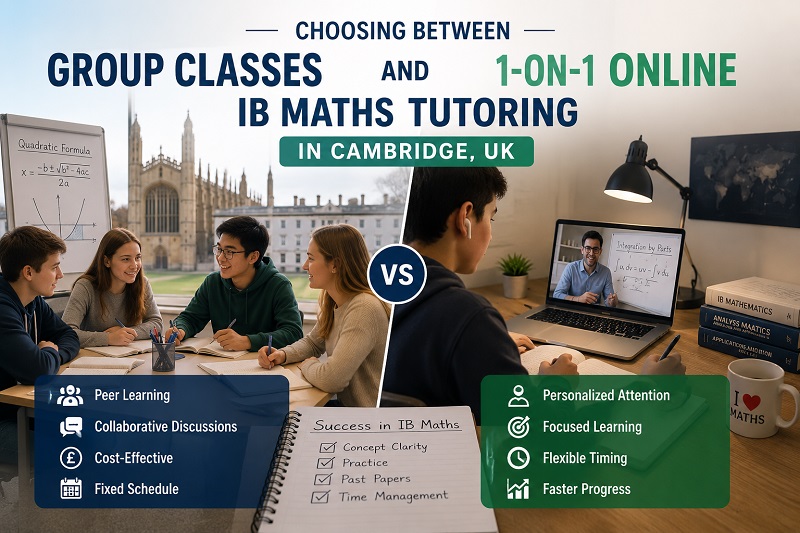
Students preparing for IB Maths Analysis & Approaches (AA) or Applications & Interpretation (AI) in Cambridge often face the same early decision: should they join a group class or work with a private, one-on-one tutor? Both formats can lead to strong results, but they suit different learning styles, budgets, and timelines. This guide breaks down the real differences so you can make an informed choice — whether you’re a student weighing your options or a parent trying to support your child through the IB Diploma Programme.
Quick Answer: Which Is Better for IB Maths?
There is no single “better” option — it depends on the student. Group classes work well for students who are broadly on track, learn well from peer discussion, and need structured, syllabus-paced revision at a lower cost. 1-on-1 tutoring works better for students who have specific gaps, need a flexible pace, are aiming for top grades (6s and 7s), or are preparing for the Internal Assessment (IA), where individual feedback matters most.
Below, we unpack the factors that actually drive this decision.
Understanding the Two Formats
What Group IB Maths Classes Look Like
Group classes for IB Maths in Cambridge typically run with 4–10 students, following a fixed syllabus schedule week by week. Sessions are usually built around a specific topic — calculus, statistics, vectors, or exam technique — and move at a pace set for the “average” student in the room.
Group classes are often delivered online via live video sessions, sometimes recorded for later review. This format suits students who:
- Are comfortable asking questions in front of others
- Benefit from hearing how classmates approach the same problem differently
- Want a lower-cost way to stay consistent with revision
- Are performing at a similar level to their peers in the group
What 1-on-1 Online IB Maths Tutoring Looks Like
One-on-one tutoring pairs a single student with a tutor for the full session. The content, pace, and focus areas are built entirely around that student’s current understanding, target grade, and exam board requirements (SL or HL, AA or AI).
This format is common for:
- Students targeting a specific weak topic (e.g., trigonometric identities, probability distributions)
- IA supervision, where a tutor reviews drafts and gives targeted, private feedback
- Students who need to move faster or slower than a standard class pace
- Learners who feel anxious asking questions in a group setting
Key Factors to Consider Before Choosing
1. Current Grade Level and Target Grade
A student sitting comfortably at a 5 and aiming for a 6 may benefit hugely from structured group revision that reinforces exam technique across the full syllabus. A student stuck at a 3 or 4, or one aiming for a 7, usually needs individual diagnosis of why marks are being lost — something a group format can’t easily provide, since the tutor can’t tailor pace or explanation to one person’s specific misunderstanding.
2. Learning Style and Confidence
Some students learn best by watching a problem solved multiple ways by different peers — a natural strength of group classes. Others need a quieter environment to work through a topic without the pressure of a group watching them struggle. If a student tends to stay silent in class rather than admit confusion, 1-on-1 sessions often surface and resolve gaps faster.
3. Timeline to Exams
Group classes are efficient for early and mid-Diploma Programme revision (Year 1, early Year 2), when the goal is steady coverage of the syllabus. Closer to exams — particularly in the final 3–6 months — many Cambridge-based IB students shift toward 1-on-1 sessions to target specific past-paper weaknesses, since there’s no time left for a fixed group curriculum to catch up to individual needs.
4. Internal Assessment (IA) Support
The Maths IA is inherently individual: each student chooses their own topic and mathematical exploration. Group classes can offer general guidance on IA structure and mark scheme criteria, but detailed, draft-by-draft feedback on a student’s specific exploration is far more effective one-on-one, where a tutor can engage directly with that student’s chosen mathematics.
5. Budget and Frequency
Group classes generally cost less per session because the cost is shared across several students, making them more sustainable for weekly, long-term revision. 1-on-1 tutoring costs more per hour but often requires fewer total hours to resolve a specific problem, since every minute is focused on that one student.
6. Scheduling Flexibility
Group classes run on fixed timetables that suit the majority of the group. 1-on-1 tutoring can usually be scheduled around a student’s other commitments — sports, other subjects, extended essay deadlines — which matters for IB students juggling six subjects plus CAS, TOK, and the Extended Essay.
Group vs 1-on-1: Side-by-Side Comparison
| Factor | Group Classes | 1-on-1 Tutoring |
|---|---|---|
| Pace | Fixed, set by group average | Fully adaptive to the student |
| Cost per session | Lower | Higher |
| Best for | General syllabus coverage | Specific gaps, IA support, top grades |
| Feedback depth | General, shared across students | Individual and detailed |
| Scheduling | Fixed timetable | Flexible |
| Confidence-building | Peer discussion, shared struggle | Private, pressure-free environment |
| Ideal timing | Early to mid-DP | Pre-exam, targeted revision, IA period |
Can You Combine Both Formats?
Yes — and many Cambridge IB students do. A common approach is to use group classes for consistent, lower-cost syllabus coverage throughout Year 1 and Year 2, then bring in short blocks of 1-on-1 tutoring around specific weak topics, mock exam preparation, or IA supervision closer to the final exams. This hybrid model balances cost with targeted support at the moments it matters most.
Frequently Asked Questions
Is 1-on-1 tutoring necessary to get a 7 in IB Maths?
Not necessarily. Some students reach a 7 through consistent group class attendance combined with independent past-paper practice. However, 1-on-1 tutoring becomes more valuable at the top end of the grade scale because the difference between a 6 and a 7 often comes down to small, specific errors that are easier to identify and correct in an individual setting.
How many hours of 1-on-1 IB Maths tutoring are typically needed before exams?
This varies widely depending on the starting grade and target grade, but many students in Cambridge use weekly 1-hour sessions in the final two terms before exams, with additional sessions added around mock exams and IA deadlines.
Are online IB Maths tutors as effective as in-person tutors in Cambridge?
Online tutoring can be just as effective for IB Maths, since much of the subject relies on shared digital whiteboards, worked examples, and past-paper walkthroughs — all of which translate well to video call formats. The key factor is the tutor’s familiarity with the current IB Maths AA/AI syllabus, not the delivery medium itself.
Should AA and AI students be tutored differently?
Yes. Analysis & Approaches (AA) has a stronger emphasis on pure mathematical proof, algebraic manipulation, and calculus depth, while Applications & Interpretation (AI) focuses more on statistical modelling, technology use, and real-world application. Group classes and tutors should be matched to the correct course, as exam technique and common pitfalls differ between the two.
What’s the difference between SL and HL support needs?
Standard Level (SL) students generally need efficient coverage of a narrower syllabus with strong exam technique, while Higher Level (HL) students often need more time on additional pure-maths content (such as further calculus and complex numbers) and benefit more from individual pacing due to the volume of material.
Making the Right Choice for Your Situation
There’s no universally correct answer between group classes and 1-on-1 tutoring — the right choice depends on where a student currently stands, how much time is left before exams, and what specifically needs to improve. Students who are broadly on track often do well with structured group revision, while those with specific gaps, IA needs, or ambitions for top grades tend to benefit more from individualised, 1-on-1 support. For many Cambridge IB Maths students, the most effective path combines both: steady group-based coverage of the syllabus, paired with focused 1-on-1 sessions when a particular topic, paper, or assessment needs closer attention.