
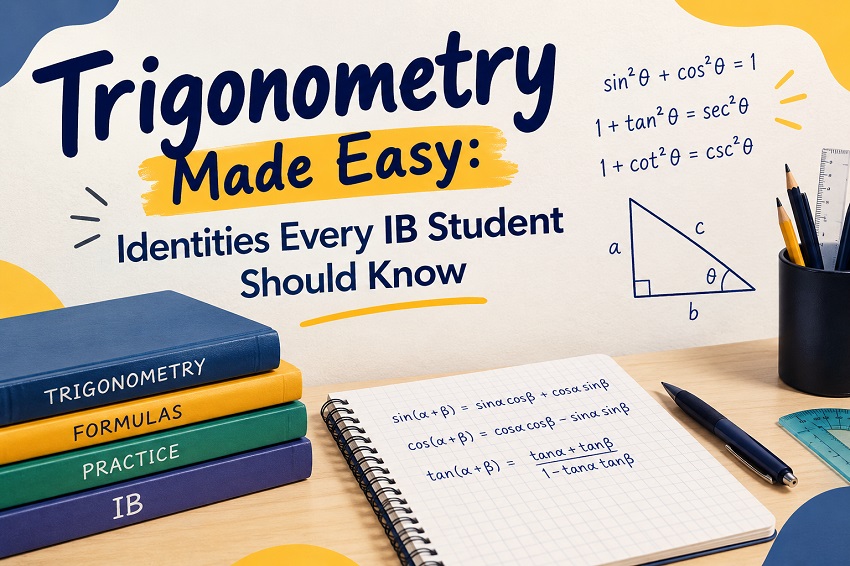
Trigonometry appears in almost every IB Maths paper, from simple triangle problems to HL proofs. Students who know their identities and when to use them solve problems faster and lose fewer marks. This guide covers every identity you need, what is (and isn’t) in the formula booklet, and how to apply each one.
What Are Trigonometric Identities?
A trigonometric identity is an equation involving trig functions that is true for every angle where both sides are defined. For example, sin²θ + cos²θ = 1 holds for every value of θ. Identities let you simplify expressions, solve equations, and prove results.
Which Trig Identities Are Needed in IB Maths?
The identities you need depend on your course:
| Course | Identities required |
|---|---|
| Maths AA SL | Basic ratios, Pythagorean identity, double angle formulas for sin and cos |
| Maths AA HL | All of the above, plus reciprocal functions, extended Pythagorean identities, compound angle formulas, double angle for tan, and inverse functions |
| Maths AI SL/HL | Mainly right-angled and non-right-angled triangle trigonometry, the sine and cosine rules, and trig modelling (identities are used far less) |
If you are taking AA, this article is essential. If you are taking AI, focus on the first three sections.
1. The Basic Trigonometric Ratios
Everything starts with a right-angled triangle:
- sin θ = opposite ÷ hypotenuse
- cos θ = adjacent ÷ hypotenuse
- tan θ = opposite ÷ adjacent
The first identity you should know follows directly from these:
tan θ = sin θ ÷ cos θ
This is useful whenever a question mixes tan with sin and cos. Rewriting everything in terms of sin and cos is often the first step in a proof.
2. The Pythagorean Identity (The Most Important One)
sin²θ + cos²θ = 1
This comes from Pythagoras’ theorem applied to the unit circle, where the point (cos θ, sin θ) always lies at distance 1 from the origin.
Rearranged versions you will use constantly:
- sin²θ = 1 − cos²θ
- cos²θ = 1 − sin²θ
Example: If sin θ = 3/5 and θ is acute, find cos θ.
cos²θ = 1 − (3/5)² = 1 − 9/25 = 16/25, so cos θ = 4/5.
Exam tip: When a question contains both sin² and cos² terms, or asks you to solve an equation with a mix of sin and cos, try this identity first.
3. Reciprocal Trig Functions (AA HL)
HL students need three more functions:
- sec θ = 1 ÷ cos θ
- cosec θ = 1 ÷ sin θ
- cot θ = 1 ÷ tan θ = cos θ ÷ sin θ
4. Extended Pythagorean Identities (AA HL)
Dividing sin²θ + cos²θ = 1 by cos²θ or sin²θ gives two more identities:
- 1 + tan²θ = sec²θ
- 1 + cot²θ = cosec²θ
Quick way to remember: each identity is “1 plus the square of one function equals the square of its partner.” These are particularly useful in integration and in proofs.
5. Double Angle Identities
These are some of the most frequently tested identities in the course.
Sine:
- sin 2θ = 2 sin θ cos θ
Cosine (three equivalent forms):
- cos 2θ = cos²θ − sin²θ
- cos 2θ = 2cos²θ − 1
- cos 2θ = 1 − 2sin²θ
Tangent (HL):
- tan 2θ = 2 tan θ ÷ (1 − tan²θ)
Which form of cos 2θ should you choose? Choose based on what the question contains:
- If the question involves only cos θ, use 2cos²θ − 1.
- If it involves only sin θ, use 1 − 2sin²θ.
- If it involves both, use cos²θ − sin²θ.
Example: Solve cos 2θ + 3 sin θ − 2 = 0 for 0 ≤ θ ≤ 2π.
Replace cos 2θ with 1 − 2sin²θ:
1 − 2sin²θ + 3 sin θ − 2 = 0
−2sin²θ + 3 sin θ − 1 = 0
2sin²θ − 3 sin θ + 1 = 0
(2 sin θ − 1)(sin θ − 1) = 0
So sin θ = 1/2 or sin θ = 1, giving θ = π/6, 5π/6, π/2.
This is a classic exam pattern: use an identity to turn the equation into a quadratic in one trig function, then factorise.
6. Compound Angle Identities (AA HL)
These let you expand the sine, cosine, or tangent of a sum or difference of two angles:
- sin(A ± B) = sin A cos B ± cos A sin B
- cos(A ± B) = cos A cos B ∓ sin A sin B
- tan(A ± B) = (tan A ± tan B) ÷ (1 ∓ tan A tan B)
Notice that cos flips the sign: cos(A + B) has a minus, and cos(A − B) has a plus. This is the most common slip students make.
Example: Find the exact value of sin 75°.
sin 75° = sin(45° + 30°) = sin 45° cos 30° + cos 45° sin 30°
= (√2/2)(√3/2) + (√2/2)(1/2)
= (√6 + √2) ÷ 4
Double angle formulas are just compound angle formulas with A = B, which is a helpful way to remember how they connect.
7. Symmetry and Periodicity Identities
These come from the unit circle and help you find values and solve equations:
- sin(−θ) = −sin θ
- cos(−θ) = cos θ
- tan(−θ) = −tan θ
- sin(π − θ) = sin θ
- cos(π − θ) = −cos θ
- sin(π/2 − θ) = cos θ
- cos(π/2 − θ) = sin θ
Sin and cos have a period of 2π (360°), and tan has a period of π (180°).
8. Exact Values You Should Memorise
The formula booklet does not give you the standard exact values, so learn them:
| Angle | sin | cos | tan |
|---|---|---|---|
| 0° (0) | 0 | 1 | 0 |
| 30° (π/6) | 1/2 | √3/2 | 1/√3 |
| 45° (π/4) | √2/2 | √2/2 | 1 |
| 60° (π/3) | √3/2 | 1/2 | √3 |
| 90° (π/2) | 1 | 0 | undefined |
Sketching the unit circle quickly lets you recover values for other quadrants.
9. Triangle Rules (Non-Right-Angled Triangles)
These appear in both AA and AI and are included in the formula booklet:
- Sine rule: a ÷ sin A = b ÷ sin B = c ÷ sin C
- Cosine rule: c² = a² + b² − 2ab cos C
- Area of a triangle: ½ab sin C
Use the sine rule when you have a matching angle-and-side pair. Use the cosine rule when you know two sides and the included angle, or all three sides. With the sine rule, watch for the ambiguous case, where two different triangles may fit the information.
10. Radians, Arc Length, and Sector Area
- Arc length: l = rθ
- Sector area: A = ½r²θ
Both formulas require θ in radians. To convert, multiply degrees by π/180. Always check your calculator mode before starting an exam question.
Common Mistakes IB Students Make with Trig Identities
- Writing sin²θ as sin θ². The correct meaning is (sin θ)².
- Cancelling “sin” like a number. sin θ / sin 2θ does not simplify to 1/2.
- Getting the cos compound sign wrong. Remember the flip.
- Losing solutions. Within a given domain, sin and cos usually have two solutions, and tan can repeat every π.
- Dividing by a trig function. Dividing both sides by sin θ can lose the solutions where sin θ = 0. Factorise instead.
- Using the wrong calculator mode. Degrees and radians are not interchangeable.
How to Prove a Trig Identity: A Simple Method
HL students are often asked to “show that” or prove an identity. A reliable approach is:
- Start with one side only, usually the more complicated one.
- Rewrite everything in terms of sin and cos.
- Apply known identities such as the Pythagorean or double angle identity.
- Simplify until it matches the other side.
- Never work on both sides at once, as this is not a valid proof.
Frequently Asked Questions
Do I need to memorise trig identities for IB Maths?
Partly. Some identities appear in the formula booklet, but you should memorise the basic definitions, exact values, and symmetry relationships, and know how to use the booklet quickly.
What is the most important trig identity in IB Maths?
sin²θ + cos²θ = 1. It underpins many other identities and appears in solving equations, proofs, and calculus.
Are compound angle formulas in Maths AA SL?
No. Compound angle formulas are part of AA HL. AA SL covers the double angle formulas for sin and cos.
How can I get better at trigonometry for IB?
Practise solving equations with identities, build an error log of mistakes, work through past papers, and revisit weak areas often. Working with an experienced tutor can help you spot patterns and fix recurring errors faster.
Is trigonometry harder in AA or AI?
AA goes much deeper into identities, proofs, and equation solving. AI focuses on applying trigonometry to triangles and real-world models.
Final Thoughts
Trigonometry rewards understanding over memorisation. If you know where the identities come from (the unit circle and Pythagoras) and practise choosing the right one for each situation, even the hardest exam questions become manageable.
At IB Maths Tutor, our online tutors help IB students at SL and HL build this kind of clarity through personalised one-on-one lessons, past-paper practice, and targeted feedback. Whether you are aiming for a 7 or just want to feel more confident, the right guidance makes a real difference.
Ready to master IB trigonometry? Book a free trial session with IB Maths Tutor today.