
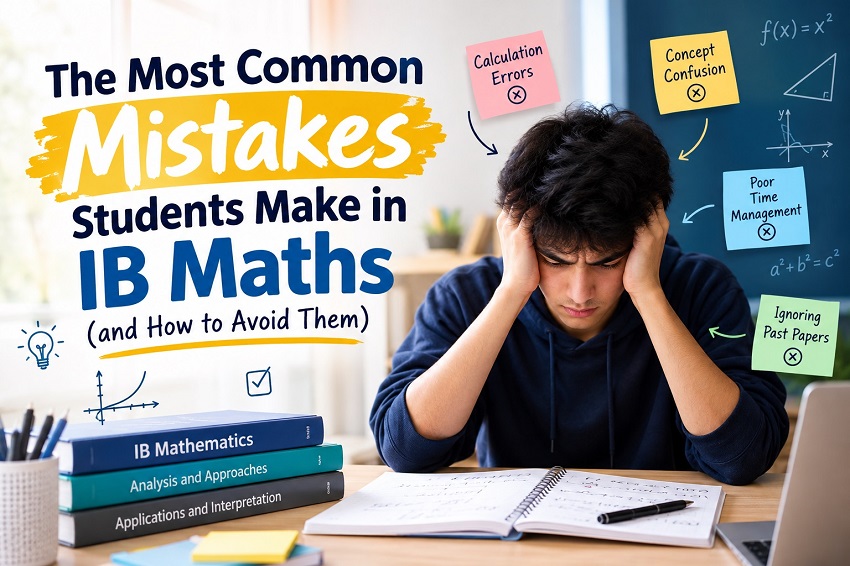
Most students do not lose IB Maths marks because the content is too hard. They lose them to avoidable habits: missing working, misread questions and rushed calculator work. At IB Maths Tutor, we see the same patterns every exam session across IB Maths AA and AI, at both SL and HL.
The good news is that every mistake below can be fixed with a small change in how you study and write answers.
What are the most common mistakes in IB Maths?
The most common IB Maths mistakes are skipping working, misreading command terms, making calculator errors, rounding too early, ignoring context and units, memorising formulas without understanding them, choosing the wrong course, poor time management, leaving the Internal Assessment (IA) too late, and using past papers passively. Each one is fixable, and the sections below explain how.
1. Skipping or shortening your working
The mistake: Writing only the final answer, especially on calculator papers.
Why it costs marks: IB mark schemes award method marks (M) and answer marks (A). A wrong answer with clear working can still earn method marks. A bare wrong answer earns nothing.
How to avoid it: Write the formula before you substitute into it. Show each step. When you use your GDC, say so, for example: “Using GDC, solve f(x) = 0.” Treat every page as an argument the examiner must be able to follow.
2. Misreading command terms
The mistake: Treating “show that,” “hence,” “justify” and “write down” as if they all mean “find.”
Why it costs marks: “Show that” gives you the answer, so the marks are for the full route to it. “Hence” means you must use the previous result. “Justify” needs a reason, not just a number.
How to avoid it: Underline the command term in every question. Keep a one-page glossary of IB command terms and what each one expects. Before writing, ask: “What does the examiner need to see?”
3. Making calculator (GDC) errors
The mistake: Working in degrees when the question needs radians, mistyping brackets, or not knowing which GDC function to use.
Why it costs marks: One wrong setting can ruin an entire question, and the error follows through every later part.
How to avoid it: Check your angle mode at the start of every paper. Practise the solver, graph sketching, regression and distribution functions (normal, binomial) until they are automatic. Store unrounded values in memory instead of retyping them.
4. Rounding too early or to the wrong accuracy
The mistake: Rounding intermediate values, or giving answers to the wrong number of significant figures.
Why it costs marks: Early rounding creates small errors that grow, so your final answer can drift outside the accepted range. Unless a question says otherwise, IB expects final answers to three significant figures.
How to avoid it: Keep full calculator values during the working. Round only the final answer. If an exact value is possible, give it.
5. Ignoring context, units and reasonableness
The mistake: Leaving a probability of 1.4, a negative length, or an answer with no units and no sentence of conclusion.
Why it costs marks: IB Maths, especially AI, rewards applying maths to real situations. A correct number without context can lose the final mark.
How to avoid it: Ask “Does this make sense?” after every answer. Add units, and finish modelling questions with a one-line conclusion in the context of the problem.
6. Memorising formulas without understanding them
The mistake: Relying on the formula booklet or on memory without knowing when and why a formula applies.
Why it costs marks: IB questions are often set in unfamiliar contexts. Students who only memorise cannot tell which tool a problem needs.
How to avoid it: For each topic, practise identifying the method before solving. Ask “Why does this formula work?” Rework every wrong answer until you can explain the correct method in your own words.
7. Choosing the wrong course (AA vs AI)
The mistake: Picking IB Maths Analysis and Approaches (AA) or Applications and Interpretation (AI) based on what friends chose, or on which seems easier.
Why it costs marks: AA is more algebra, calculus and proof based. AI is more focused on statistics, modelling and technology. Picking the wrong fit can hurt both your grade and your university options.
How to avoid it: Check the maths requirements of your target university courses early. Match the course to your strengths and future plans, and talk to your teacher or tutor before committing.
8. Poor time management in exams
The mistake: Spending too long on one hard question and rushing the rest.
Why it costs marks: Easy marks in later questions go uncollected, and a stuck student often gains nothing from the extra minutes.
How to avoid it: Use marks as a guide: roughly one minute per mark. If you are stuck, write what you know, move on, and return later. Practise full papers under timed conditions.
9. Leaving the Internal Assessment (IA) too late
The mistake: Choosing a topic in a hurry, describing the maths instead of using it, or writing the exploration in the final weeks.
Why it costs marks: The IA is assessed on criteria such as mathematical communication, personal engagement and reflection. Rushed work rarely shows any of them.
How to avoid it: Choose a topic that genuinely interests you and fits your level. Build a clear structure, include real reflection, and set internal deadlines. Seek feedback early, within your school’s academic honesty rules.
10. Using past papers passively
The mistake: Doing papers without marking them properly, or doing too many without learning from them.
Why it costs marks: Repeating the same errors feels like practice but builds no new skill.
How to avoid it: Do papers under timed conditions, mark them strictly against the official mark scheme, and keep an error log. Note each mistake, its cause and the fix, then redo similar questions a week later.
Quick checklist before you hand in any IB Maths paper
- Is every answer supported by clear working?
- Did I follow the command term in each question?
- Is my GDC in the correct mode?
- Are final answers correctly rounded, with units where needed?
- Does each answer make sense in context?
Frequently asked questions
What is the hardest part of IB Maths? It varies by student. Many find calculus, functions and applying concepts to unfamiliar contexts the most demanding. HL students often add proof and complex numbers to that list.
How can I improve my IB Maths grade quickly? Keep an error log, practise timed past papers, and focus on earning method marks by showing full working. Fixing a few repeated mistakes often raises a grade faster than learning new content.
Is IB Maths AA harder than AI? Not directly. AA is more algebra and proof heavy, while AI leans on statistics and modelling. Which is harder depends on your strengths and goals.
Can online IB Maths tutoring help avoid these mistakes? Yes. A tutor can spot your repeated error patterns, give instant feedback on written working, and build targeted practice around your weak areas. Online sessions with a digital whiteboard make this flexible from anywhere.
When should I start preparing for IB Maths exams? Ideally from the start of the course. At minimum, begin structured revision and timed practice six months before the exams.
Final thoughts
High IB Maths grades come from consistent habits, not last-minute cramming. Show your working, read command terms carefully, master your GDC, and learn from every error. Small corrections add up to big mark gains.
If you want personalised help finding and fixing your own mistakes, IB Maths Tutor offers one-to-one online lessons for IB Maths AA and AI at SL and HL, including IA guidance and exam preparation. Book a trial session to see where your marks are slipping and how to win them back.