
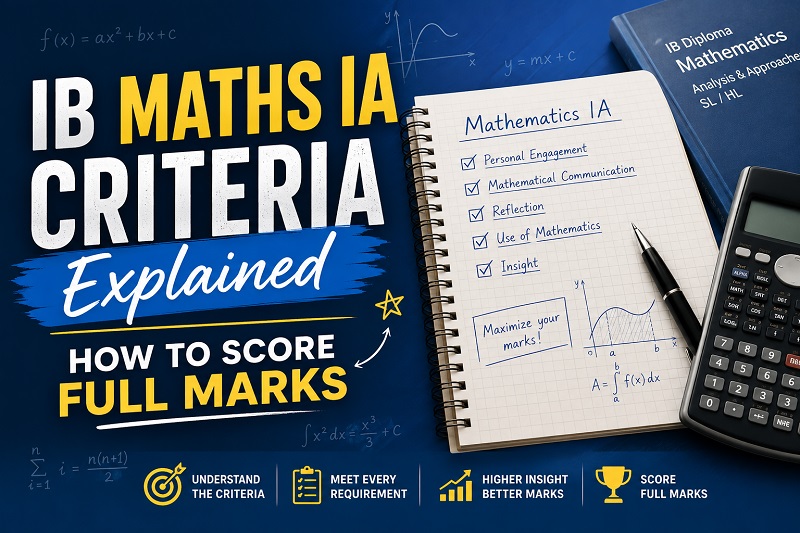
Quick Answer: The IB Maths Internal Assessment is marked out of 20 across five criteria — Communication, Mathematical Presentation, Personal Engagement, Reflection, and Use of Mathematics. Understanding exactly what each criterion demands is the fastest way to significantly improve your IA score.
What is the IB Maths Internal Assessment?
The IB Mathematics Internal Assessment (IA) is an individual mathematical exploration that every IB Maths student must complete, regardless of whether they are studying Analysis & Approaches (AA) or Applications & Interpretation (AI) at Higher Level or Standard Level. It counts for 20% of your final IB Maths grade — making it one of the single most important components of the entire course.
The IA is a 12 to 20 page written exploration of a mathematical topic of your choice. It is not a research essay and it is not a textbook exercise — it is your personal investigation into a mathematical idea that genuinely interests you. The best IAs read like a mathematician thinking out loud: curious, structured, and analytical.
Yet despite its weight, the IB Maths IA remains one of the most misunderstood assessments in the entire Diploma Programme. Students consistently lose marks not because they cannot do the mathematics, but because they do not understand what the five assessment criteria actually require. This guide breaks down every criterion in precise detail so you know exactly where marks come from — and exactly how to earn all of them.
The Five IB Maths IA Criteria at a Glance
The IB Maths IA is assessed across five criteria, each worth a specific number of marks:
| Criterion | Marks Available |
|---|---|
| A — Communication | 4 marks |
| B — Mathematical Presentation | 3 marks |
| C — Personal Engagement | 3 marks |
| D — Reflection | 3 marks |
| E — Use of Mathematics | 6 marks |
| Total | 20 marks |
Each criterion has specific descriptors that IB examiners use when awarding marks. Understanding these descriptors is not optional — it is essential. Let us go through each one in detail.
Criterion A — Communication (4 Marks)
What it assesses: How well your exploration is organized, focused, and easy for the reader to follow.
Communication is about clarity and coherence. The examiner should be able to read your IA from beginning to end and clearly understand what you are exploring, why you made each mathematical decision, and what your findings mean. A disorganized IA with brilliant mathematics will still lose Communication marks.
To score full marks in Communication:
Your exploration must have a clear and focused aim stated early. The reader should understand within the first page exactly what mathematical question you are investigating and why. Every section of your exploration should logically connect to this central aim — if a paragraph or calculation does not contribute to your exploration, remove it.
Use precise mathematical language throughout. Define every variable you introduce. Explain every step of your working in plain English alongside the mathematical notation. Do not assume the reader knows what you are doing — explain your reasoning as you go.
Structure your exploration with a clear introduction, development, and conclusion. Use section headings to guide the reader. Avoid padding with irrelevant content — a focused 14-page IA scores higher on Communication than a rambling 22-page one.
Common Communication mistakes:
- Starting the exploration without a clearly stated aim
- Including long sections of background information that do not contribute to the mathematical investigation
- Jumping between topics without connecting them
- Writing a conclusion that does not refer back to the original aim
Criterion B — Mathematical Presentation (3 Marks)
What it assesses: Whether mathematical concepts, results, and conclusions are expressed correctly using appropriate notation, symbols, and diagrams.
Mathematical Presentation is specifically about how you write and display mathematics — not the quality of the mathematics itself. This criterion rewards students who present their work professionally and accurately.
To score full marks in Mathematical Presentation:
All mathematical notation must be correct and consistent. Use proper notation for functions, derivatives, integrals, matrices, vectors, and any other mathematical objects in your exploration. Do not mix informal and formal notation within the same exploration.
Every graph, table, diagram, and chart must be clearly labelled. Axes on graphs must have titles and units where appropriate. Tables must have column headers. Every visual element must be referenced in the text — never include a graph without explaining what it shows and why it matters.
Use technology appropriately. GDC outputs, Desmos graphs, and GeoGebra diagrams are all acceptable but must be integrated properly into the exploration — not simply pasted in without context. Screenshot outputs must be legible and clearly explained.
Common Mathematical Presentation mistakes:
- Unlabelled or poorly labelled graphs and tables
- Inconsistent notation (mixing degrees and radians, using informal symbols)
- Pasting raw technology output without explanation
- Writing mathematical expressions in plain text instead of proper notation
Criterion C — Personal Engagement (3 Marks)
What it assesses: The extent to which the exploration shows evidence of independent thinking, creativity, and genuine personal interest in the topic.
Personal Engagement is the criterion that separates a mechanical IA from a genuinely impressive one. Examiners are looking for evidence that this exploration belongs to you — that you made independent choices, asked your own questions, and brought something personal to the mathematics.
To score full marks in Personal Engagement:
Choose a topic you are genuinely curious about. The most common reason students score low on Personal Engagement is that their topic was suggested entirely by their teacher or copied from an example IA. Your topic should connect to something in your own life — a sport you play, a piece of music you love, a financial concept you find interesting, a natural phenomenon you want to model.
Show independent thinking throughout. Do not just apply a formula you found — question it, extend it, test its limitations, and investigate what happens when you change the conditions. Ask “what if?” questions and follow them mathematically.
Make choices and explain why you made them. Every time you choose a particular mathematical approach, model, or method, briefly explain your reasoning. This demonstrates that you are thinking independently, not just following a template.
Common Personal Engagement mistakes:
- Using a topic that is extremely common and shows no personal connection (e.g. “the golden ratio” with no personal context)
- Following a rigid template without any independent questioning
- Not explaining why you chose your specific approach or method
- An exploration that reads like a textbook chapter rather than a personal investigation
Criterion D — Reflection (3 Marks)
What it assesses: How critically and thoughtfully you consider the significance, limitations, and implications of your mathematical findings.
Reflection is perhaps the most underrated criterion in the IB Maths IA. Many students treat reflection as a brief final paragraph — a summary of what they did. This is not what reflection means in the IB context. True reflection is woven throughout the exploration and involves genuine critical thinking about your results.
To score full marks in Reflection:
Reflect throughout the exploration, not just at the end. After each significant finding, pause and consider what it means. Is the result what you expected? Why or why not? What does it tell you about the mathematical model or the real-world situation you are investigating?
Discuss limitations honestly and specifically. Every mathematical model has limitations. Every dataset has gaps. Every method has assumptions. Identify these limitations with precision — not vague statements like “the model is not perfect” but specific observations like “the quadratic model assumes a constant rate of change which does not reflect the real-world variability in the data.”
Consider extensions and future directions. What questions does your exploration raise that you have not answered? What would you investigate if you had more time or data? These forward-looking reflections demonstrate genuine mathematical curiosity.
Common Reflection mistakes:
- Only reflecting in the conclusion
- Vague, generic reflections that could apply to any exploration
- Identifying limitations without explaining why they matter
- Failing to reflect on unexpected results or anomalies
Criterion E — Use of Mathematics (6 Marks)
What it assesses: The sophistication, accuracy, and rigour of the mathematics used in the exploration.
Use of Mathematics carries the most marks (6 out of 20) and is also the criterion where HL and SL students are assessed differently. This criterion evaluates not just whether your mathematics is correct, but whether it is appropriately sophisticated for your level and applied with genuine understanding.
For SL students — to score full marks:
The mathematics must be at SL standard or beyond — it cannot be purely pre-IB level content. It must be relevant to the exploration and applied correctly throughout. Computational errors should be minimal and where they occur, the method should still be clear. The mathematics must demonstrate understanding, not just mechanical application.
For HL students — to score full marks:
HL students are expected to use mathematics that is clearly beyond SL level. This means engaging with HL-specific content such as complex numbers, advanced calculus, vectors in 3D, proof, or advanced statistics. The mathematics must be sophisticated, precise, and demonstrate clear understanding of the underlying concepts — not just the ability to apply algorithms.
To score full marks in Use of Mathematics at either level:
Ensure your mathematical working is complete and shown clearly. Examiners cannot award marks for calculations they cannot see. Every step of every significant calculation must be visible and explained.
Avoid relying entirely on technology. While GDC and software outputs are acceptable, you must demonstrate that you understand the mathematics behind the outputs. Explain what the technology is calculating and why the result makes sense.
Aim for mathematics that is genuinely appropriate to your exploration — not artificially forced in to appear sophisticated. A well-applied simple technique scores better than a poorly understood complex one.
Common Use of Mathematics mistakes:
- Using mathematics that is below the expected level for HL or SL
- Showing final answers without working
- Relying on technology without demonstrating understanding
- Mathematical errors that suggest the method itself is not understood
How to Structure Your IB Maths IA for Maximum Marks
Based on the five criteria, a high-scoring IB Maths IA typically follows this structure:
Introduction (1-2 pages): State your aim clearly. Explain your personal connection to the topic. Outline what mathematical approach you will take and why.
Mathematical Development (8-12 pages): Present your mathematics systematically. Show all working. Include graphs, tables, and diagrams with full labels. Reflect on findings as you go. Demonstrate personal engagement through independent questions and decisions.
Conclusion (1-2 pages): Summarise your findings in relation to your original aim. Reflect critically on limitations. Suggest meaningful extensions.
Bibliography: Reference any external sources used for context or data.
Final Tips to Score Full Marks in IB Maths IA
Start early — the IA cannot be completed well in a few days. Give yourself at least 6-8 weeks from topic selection to final submission.
Choose a topic with genuine mathematical depth. The best topics allow you to apply multiple mathematical techniques, produce interesting results, and raise further questions.
Draft, review, and redraft. Your first draft will not score full marks. Use the five criteria as a checklist when reviewing each draft.
Get feedback before submission. A specialist IB Maths tutor who understands the assessment criteria can identify exactly where marks are being lost and how to recover them before it is too late.