
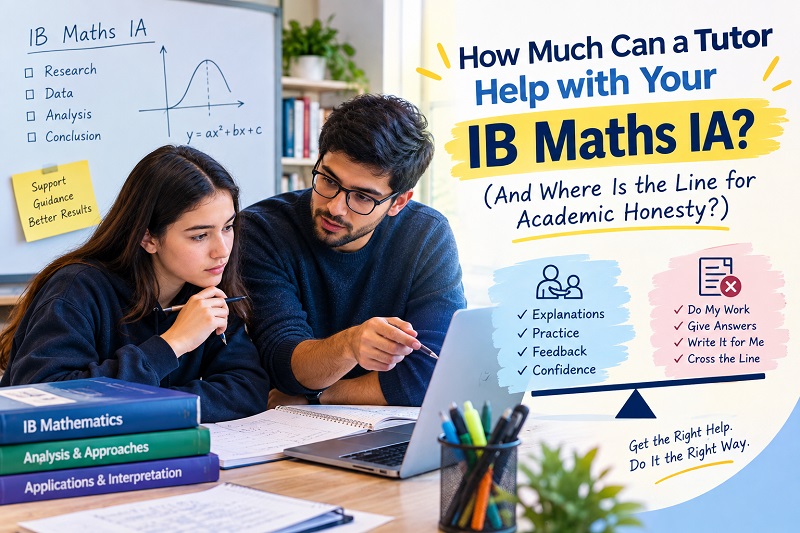
The Short Answer
A tutor can help you understand mathematics, choose and refine a topic, and give feedback on your draft. A tutor cannot write, solve, or substantially rewrite your IA for you. The IB Maths Internal Assessment (IA) must be your own work. Support that builds your understanding is ethical. Support that replaces your thinking is academic misconduct.
At IB Maths Tutor, we help students every year with their Mathematical Exploration, and we draw this line clearly. Here’s exactly where it sits.
What Is the IB Maths IA?
The IB Maths IA, called the Mathematical Exploration, is an individual piece of written work in which you investigate a mathematical topic of your choice. It applies to both Mathematics: Analysis and Approaches (AA) and Mathematics: Applications and Interpretation (AI), at Standard and Higher Level.
Key facts:
- It counts for 20% of your final IB Maths grade.
- It is marked out of 20 marks by your teacher and moderated by the IB.
- It is typically 12 to 20 pages long.
- It is assessed against five criteria: Presentation, Mathematical Communication, Personal Engagement, Reflection, and Use of Mathematics.
Because the IA rewards your engagement, understanding, and voice, it is one of the areas where the rules on outside help matter most.
Why Do Students Seek IA Tutoring?
Most students who look for an IB Maths IA tutor are stuck in one of these places:
- They can’t find a topic that is both interesting and mathematically rich enough.
- The topic is too broad or too basic, so it can’t earn high marks under Use of Mathematics.
- They don’t understand the criteria, especially Personal Engagement and Reflection.
- They understand the maths but struggle to communicate it clearly in writing.
- They are short on time while juggling the rest of the IB Diploma.
Every one of these is a legitimate reason to get help. The question is what kind of help.
What a Tutor CAN Do: Ethical IA Support
The IB expects students to receive guidance from teachers and others. Ethical tutoring focuses on developing your skills, not producing your content. A good tutor can:
1. Help you brainstorm and evaluate topics
A tutor can suggest areas to explore, such as optimisation, modelling, or number theory, and help you judge whether an idea is feasible and at the right level. The final choice, and the personal connection to it, must be yours.
2. Teach the underlying mathematics
If your topic involves differential equations, Markov chains, or Fourier series, a tutor can teach you the concepts you need. Learning new maths is exactly what the IA encourages.
3. Explain the assessment criteria
Understanding what examiners look for is not cheating. A tutor can break down each criterion in plain language and show you what a strong response looks like.
4. Give feedback on your draft
Reviewing a draft and saying, “This section lacks justification,” or “Your notation is inconsistent,” is standard, acceptable feedback. The key is that you make the changes.
5. Ask guiding questions
Good tutors ask, “Why did you choose this model?” or “What are the limitations here?” These questions push you to think and improve your Reflection marks without handing you answers.
6. Help with mathematical software
Tutors can show you how to use tools like Desmos, GeoGebra, Python, or Excel. You still run the analysis and interpret the results.
7. Improve your mathematical writing
A tutor can point out unclear explanations, missing definitions, or poorly labelled graphs, and teach you how to fix them.
What a Tutor CANNOT Do: Crossing the Line
The following are academic misconduct and can seriously damage your IB Diploma:
- Writing any part of your IA, including sentences, paragraphs, or reflections.
- Solving the mathematics for you and having you copy the working.
- Choosing your topic and building the full structure with no real input from you.
- Rewriting your draft so heavily that the final text is no longer yours.
- Supplying data, graphs, or code that you present as your own analysis.
- Fabricating personal engagement, such as writing a reflection about experiences you never had.
If you couldn’t explain every line of your IA in a conversation with your teacher or examiner, something has gone wrong.
The Academic Honesty Line at a Glance
| Ethical tutor support | Academic misconduct |
|---|---|
| Suggesting topic directions | Assigning you a finished topic and outline |
| Teaching a new mathematical concept | Doing the calculations for you |
| Pointing out unclear explanations | Rewriting your paragraphs |
| Asking guiding questions | Writing your reflection |
| Explaining marking criteria | Producing sections you submit as your own |
| Showing how to use software | Running the analysis and giving you results |
A useful test: Who did the thinking? If the ideas, decisions, and words are yours, the help was acceptable.
What Are the Consequences of Crossing the Line?
The IB takes academic integrity seriously. Submitted work is authenticated by your teacher and can be checked using plagiarism-detection software. If the IB finds malpractice, possible outcomes include losing marks for the component or being denied the subject grade or even the Diploma.
Beyond the penalties, there is a practical risk: your IA can be sampled for moderation, and your teacher may question work that doesn’t match your usual level or your ability to explain it. Work that isn’t yours is hard to defend.
A Note on AI Tools and the IA
Many students now use AI chatbots for ideas or explanations. The IB expects any use of AI to be transparent and properly acknowledged, and the work you submit must remain your own. AI-generated text, calculations, or analysis presented as your own is misconduct. The same principle applies to a human tutor: tools and tutors can support your learning, but they cannot replace it. Always check your school’s academic integrity policy and confirm with your IB Maths teacher what is permitted.
How Much Can a Tutor Improve Your IA Score?
Realistically, a good tutor can raise your IA mark by helping you in areas where students most often lose points:
- Use of Mathematics (6 marks): choosing a topic with enough depth and applying maths at the right level, with correct and thorough working.
- Reflection (3 marks): moving beyond “this was interesting” to critical evaluation of limitations, assumptions, and extensions.
- Personal Engagement (3 marks): showing genuine curiosity and independent thinking.
- Communication (4 marks) and Presentation (4 marks): structuring your exploration logically with clear notation and concise writing.
A tutor won’t guarantee a 20/20, and be cautious of anyone who promises that. What tutoring can do is help you avoid common mistakes, build confidence, and present your best original work.
How to Get the Most from an IA Tutor (Ethically)
- Start early. Begin topic exploration at least a few months before your deadline.
- Come prepared. Bring your own ideas, drafts, and questions to each session.
- Do the work yourself. Use sessions to check your understanding, not to hand off tasks.
- Keep records. Save drafts and notes to show how your work developed.
- Stay in touch with your teacher. Your school’s guidance always comes first.
- Ask “why?” Make sure you can justify every step in your IA.
How to Spot an Unethical IA Service
Watch out for tutors or “IA help” services that:
- Promise a specific score or a guaranteed 7.
- Offer to “write your IA” or sell “IA samples” for you to adapt.
- Don’t ask about your interests or your ideas.
- Avoid discussing academic honesty.
A reputable tutor will welcome questions about integrity and will explain their boundaries upfront.
How IB Maths Tutor Supports Your IA
At IB Maths Tutor, we teach students to think like mathematicians, not to hand in someone else’s work. Our IA support includes:
- One-to-one online sessions with experienced IB Maths specialists
- Topic brainstorming and feasibility checks
- Concept tutoring for the mathematics behind your exploration
- Criterion-by-criterion feedback on your drafts
- Guidance on notation, structure, and mathematical communication
- A firm commitment to academic honesty in every session
Your IA stays yours. We help you make it the best version of your own work.
Frequently Asked Questions
Can a tutor write my IB Maths IA?
No. Writing any part of your IA for you is academic misconduct and can lead to serious penalties, including loss of your Diploma.
Is it allowed to get an IB Maths IA tutor?
Yes. Getting tutoring is allowed as long as the tutor supports your learning and does not do the work for you. The final IA must be your own.
Can a tutor help me choose an IA topic?
Yes. A tutor can suggest directions and check whether a topic is suitable, but you should choose the topic based on your own interests.
Can a tutor check my IA before submission?
A tutor can give feedback on clarity, structure, and mathematical accuracy, but you must make the edits yourself.
What percentage of the IB Maths grade is the IA?
The IA is worth 20% of your final grade in both Maths AA and Maths AI.
How early should I start my IA?
Ideally, begin exploring topics several months before the school deadline. Early planning leaves time for drafts, feedback, and improvement.
How do I know if I’ve crossed the line?
If you can’t explain and defend every step and sentence in your IA, or if someone else produced significant parts of it, you’ve likely crossed the line. When in doubt, ask your teacher or IB coordinator.
Final Thoughts
A tutor can be one of the most valuable resources for your IB Maths IA, provided the help strengthens your understanding rather than replacing it. Use guidance to spark ideas, deepen your mathematics, and refine your communication, and keep every idea, calculation, and sentence your own.
Ready to build a strong, original IA? Book a free consultation with IB Maths Tutor and learn how our expert tutors can guide you, ethically and effectively.