
What Is the Future of IB Maths Learning?
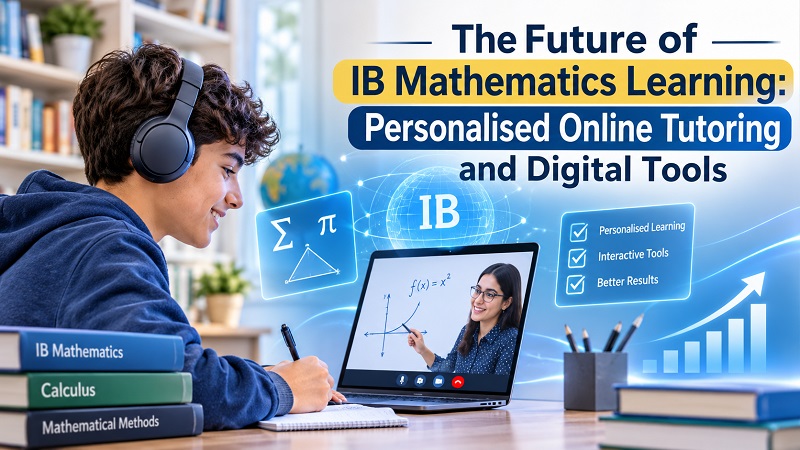
The future of IB Mathematics learning is personalised, technology-supported and flexible. Online IB maths tutoring pairs students with expert tutors who adapt every lesson to the student’s gaps, goals and pace, while digital tools such as graphic display calculators (GDCs), Desmos, GeoGebra, interactive whiteboards and recorded sessions make abstract concepts visible and revision efficient. Together, they help students move from memorising formulas to genuinely understanding mathematics.
Introduction: Why IB Maths Is Changing
The International Baccalaureate (IB) Diploma Programme has always asked more of students than recall. Mathematics, in particular, rewards reasoning, communication and the ability to apply ideas to unfamiliar problems. Yet the way most students prepare has barely changed for decades: a class of twenty or thirty, one pace for everyone, and a pile of past papers at the weekend.
That model is now being reshaped. Students expect learning that fits their schedule, responds to their mistakes in real time and uses the same technology they use everywhere else. At IB Maths Tutor, we see this shift every day. In this article, we explore where IB Mathematics learning is heading, why online IB maths tutoring is at the centre of that change, and how students and parents can make the most of it.
Why IB Mathematics Is So Demanding
Before looking at the future, it helps to understand the challenge. IB Mathematics currently offers two courses, each at Standard Level (SL) and Higher Level (HL):
- Mathematics: Analysis and Approaches (AA) focuses on algebra, functions, calculus and proof. It suits students who enjoy abstract reasoning and often plan to study mathematics, engineering or physical sciences.
- Mathematics: Applications and Interpretation (AI) emphasises modelling, statistics and technology. It suits students heading toward economics, social sciences, business or life sciences.
Both courses assess far more than procedure. Students must explain their thinking, interpret results in context, use technology accurately and complete an Internal Assessment (IA), an independent mathematical exploration that counts toward the final grade. Add the pressure of the wider Diploma, including the Extended Essay, Theory of Knowledge and CAS, and it is easy to see why many capable students struggle to find time and confidence in maths.
What Is Online IB Maths Tutoring?
Online IB maths tutoring is one-to-one or small-group instruction delivered over video, using shared digital whiteboards, screen sharing and interactive tools. A specialist tutor who knows the IB syllabus, command terms and mark schemes works with the student to close knowledge gaps, strengthen exam technique and support the IA.
Unlike generic homework help, effective online IB maths tutoring is:
- Syllabus-specific: aligned to AA or AI, SL or HL, and the current assessment objectives.
- Personalised: built around diagnostic results, not a fixed textbook sequence.
- Interactive: students work through problems live, with immediate feedback.
- Flexible: available across time zones, which matters for the global IB community.
- Documented: sessions can be recorded and notes shared, so nothing is lost between lessons.
Personalisation: The Biggest Shift in IB Maths Learning
In a busy classroom, a teacher cannot pause for the one student who never quite understood logarithm laws in Year 11. In a personalised online session, that is exactly where the lesson begins.
Personalised IB maths learning typically follows four steps:
1. Diagnose. A short assessment or past-paper analysis identifies strengths, weaknesses and recurring error patterns such as sign mistakes, misread command terms or unsupported answers.
2. Plan. The tutor builds a roadmap tied to the student’s target grade, exam date and course (for example, an HL student aiming for a 7 needs a different plan than an SL student consolidating a 5).
3. Teach and practise. Lessons target the highest-impact topics first, using worked examples, guided practice and exam-style questions.
4. Review and adapt. Progress data shapes the next session, so time is never wasted re-teaching what is already secure.
This cycle turns revision from a guessing game into a measurable process. It also builds something just as valuable as marks: confidence.
Digital Tools Transforming IB Maths Learning
Technology is not replacing mathematical thinking; it is making that thinking easier to see, test and communicate. These are the tools shaping modern IB maths preparation.
Graphic Display Calculators (GDCs)
The IB expects fluent use of a GDC, whether a TI-84, TI-Nspire or Casio model. In online sessions, tutors can screen-share GDC emulators and demonstrate regression, numerical solving, statistical tests and graph analysis step by step, so students learn the keystrokes and the reasoning behind them.
Desmos and GeoGebra
Dynamic graphing tools help students see concepts: how changing a parameter transforms a function, how a tangent approaches a derivative, or how a normal distribution shifts. They are also excellent for checking work and generating visuals for the IA.
Interactive Digital Whiteboards
Tablets and shared whiteboards allow tutors and students to write, annotate and solve problems together in real time. This recreates, and often improves on, the experience of working side by side at a desk.
Spreadsheets and Coding
Spreadsheets and basic Python are increasingly useful for modelling and data handling in IA explorations, especially in AI courses where simulation and statistics play a major role.
Recorded Sessions and Digital Notes
A recorded lesson becomes a personalised revision resource. Students can revisit a tricky proof or a Paper 2 modelling question the night before an exam, rather than relying on memory.
Adaptive Practice and AI-Assisted Feedback
Question banks that adjust difficulty and AI-assisted tools that flag common mistakes are becoming part of the toolkit. Used well, they extend practice between sessions. The key word is used well: a human tutor still provides the judgement, encouragement and mathematical insight that software cannot.
Supporting the Internal Assessment Online
The IA is often where students feel least supported. Choosing a topic, defining a question, building a model and reflecting critically are skills rarely practised in regular lessons.
Online IB maths tutoring supports the IA by helping students:
- Brainstorm personal, manageable topics linked to their interests
- Structure the exploration clearly and meet the assessment criteria
- Use technology meaningfully, not decoratively
- Strengthen mathematical communication and reflection
- Manage time with milestone planning
Tutors guide and question, but the work always remains the student’s own, in line with IB academic integrity expectations.
Key Benefits of Online IB Maths Tutoring
| Benefit | Why it matters |
|---|---|
| Tailored lessons | Time is spent on weak areas, not repeated content |
| Expert IB knowledge | Tutors understand mark schemes, command terms and examiner expectations |
| Flexible scheduling | Fits around CAS, sport, travel and exam season |
| Global access | Students can learn with specialist tutors regardless of location |
| Digital resources | Recordings, shared notes and interactive graphs aid revision |
| Confidence building | Regular feedback reduces anxiety and improves exam performance |
| Parent visibility | Progress reports show what is improving and what needs attention |
How IB Maths Tutor Approaches Learning
At IB Maths Tutor, we combine specialist IB expertise with modern digital tools. Our approach to online IB maths tutoring rests on four principles:
- Understanding before speed. We teach the why behind each method, so students can handle unfamiliar questions.
- Exam-focused practice. We train students to earn method and accuracy marks, present clear working and use the GDC efficiently.
- Individual goals. Whether a student wants to move from a 4 to a 6 or secure a 7 at HL, the plan is built around that target.
- Whole-student support. We understand the IB workload and help students prioritise, plan and stay motivated.
Challenges to Watch For (and How to Avoid Them)
Online learning is powerful, but it works best when handled thoughtfully.
- Distraction. Encourage a quiet study space and a device set up for learning.
- Over-reliance on tools. Calculators and apps should support reasoning, not replace it. Paper 1 is non-calculator in some courses, so core algebra and calculus fluency still matter.
- Passive watching. Videos alone do not build skill. Students need to attempt problems actively, ideally with live feedback.
- Generic content. Choose tutoring that is specific to IB AA or AI and the correct level.
How to Choose an Online IB Maths Tutor
Use this quick checklist:
- Does the tutor have proven experience with the IB Diploma Programme?
- Do they teach your exact course (AA or AI, SL or HL)?
- Do they offer a diagnostic assessment and a clear learning plan?
- Can they support the Internal Assessment?
- Do they use interactive tools such as shared whiteboards, Desmos, GeoGebra and GDC demonstrations?
- Is there regular feedback for students and parents?
- Is scheduling flexible enough for your time zone and workload?
The Future: What Comes Next for IB Maths Learning?
Looking ahead, expect the following trends to grow:
- Hybrid learning, blending classroom teaching with targeted online tutoring.
- Smarter analytics, giving students a clear map of topic mastery.
- More visual and interactive learning, with simulations making calculus, vectors and statistics tangible.
- Responsible AI integration, supporting practice and feedback while human tutors lead understanding and motivation.
- Greater emphasis on communication, as the IB continues to value reasoning and explanation alongside correct answers.
The common thread is personalisation. The students who thrive will be those who learn in ways designed around them.
Frequently Asked Questions
Is online IB maths tutoring as effective as in-person tutoring?
Yes, when it is interactive and well structured. Shared whiteboards, screen sharing and live feedback replicate in-person teaching, and recorded sessions add a revision advantage that traditional tutoring lacks.
When should an IB student start maths tutoring?
The earlier the better. Starting at the beginning of Year 1 helps prevent gaps from forming, but targeted support before mock exams or the final exams can still make a significant difference.
Can a tutor help with the IB Maths Internal Assessment?
A tutor can guide topic selection, structure, use of technology and reflection. The final work must be the student’s own.
Which is harder, IB Maths AA or AI?
Neither is simply easier. AA is more algebra- and proof-heavy, while AI is more focused on modelling, statistics and technology. The right choice depends on the student’s strengths and future plans.
Which digital tools are most useful for IB maths?
A GDC is essential, and Desmos and GeoGebra are excellent for visualisation and checking. Spreadsheets and basic coding can also strengthen modelling and IA work.
How many hours of tutoring are needed?
It depends on the starting point and target grade. Many students benefit from one to two focused sessions a week, increasing slightly in the months before exams.
Conclusion: Learn Smarter, Not Just Harder
The future of IB Mathematics learning is not about more worksheets or longer study hours. It is about learning that responds to the individual, uses digital tools to reveal understanding and gives students support exactly when they need it. Online IB maths tutoring brings these elements together, helping students build deeper understanding, stronger exam technique and lasting confidence.
If you or your child is ready to take IB Maths to the next level, IB Maths Tutor is here to help with personalised plans, expert guidance and modern digital tools designed for IB success.
Ready to get started? Book a free consultation with IB Maths Tutor today and discover how online IB maths tutoring can transform your results.