
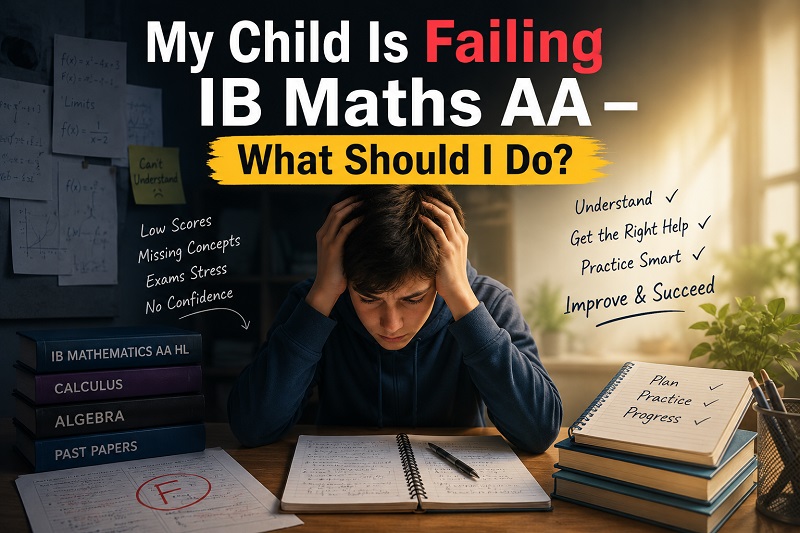
A calm, practical guide for worried parents navigating one of the toughest subjects in the IB curriculum
Every parent dreads that moment — your child comes home looking defeated, slides their test paper across the table, and you see a number that makes your stomach drop. If your child is struggling with IB Mathematics: Analysis and Approaches, you are not alone. Thousands of families around the world face this exact situation every year, and the good news is: it is absolutely fixable.
This guide will walk you through why IB Maths AA is so challenging, what warning signs to watch for, and — most importantly — what concrete steps you can take right now to turn things around before it’s too late.
First, Take a Breath — IB Maths AA Is Genuinely Difficult
Before you panic or blame your child, it helps to understand what they are actually up against.
IB Mathematics: Analysis and Approaches is one of the most academically demanding courses in the entire International Baccalaureate programme. It is designed to develop strong mathematical reasoning, abstract thinking, and the ability to apply complex concepts under exam pressure. Whether your child is taking it at Standard Level (SL) or Higher Level (HL), the pace is intense, the syllabus is vast, and the exams test deep understanding — not just memorisation.
Topics like calculus, complex numbers, vectors, proof by induction, and statistical analysis are all covered within two years. A student who was comfortably getting A’s in GCSE or middle school maths can suddenly find themselves completely lost. This is not a reflection of their intelligence. It is a reflection of how steep the jump really is.
So if your child is failing — or even just significantly underperforming — the first thing you need to do is separate the subject difficulty from your child’s capability.
What Does “Failing” Actually Look Like in IB Maths AA?
In IB grading, scores run from 1 to 7. A grade of 4 is considered a passing mark, and most universities expect at least a 5 or 6 for STEM-related courses. Here is a rough breakdown of what each score range signals:
- Grades 1–3: Serious concern. Core concepts are not landing. Immediate intervention is needed.
- Grade 4: Passing, but barely. There are significant gaps that will compound over time.
- Grade 5: Decent, but with targeted effort a 6 or 7 is within reach.
If your child is sitting at a 3 or below, do not wait for the next exam cycle to act. The IB syllabus builds on itself — gaps in algebra or functions will make calculus nearly impossible later.
Common Reasons Students Struggle With IB Maths AA
Understanding the why behind the struggle is essential before you can fix it. In most cases, the issue falls into one or more of these categories:
1. Weak Foundational Skills
IB Maths AA assumes a solid understanding of pre-calculus concepts. If your child has gaps in algebra, trigonometry, or basic function behaviour from earlier schooling, those cracks widen rapidly in IB. A student trying to differentiate composite functions while still shaky on factorisation is essentially trying to run before they can walk.
2. The Pace of the Classroom
IB teachers are working through a packed syllabus with a classroom full of students. There is very little time to revisit concepts or slow down for individual learners. If your child misses a key lesson — even due to illness — the knock-on effect can be significant.
3. Exam Technique Is Lacking
IB Maths AA exams are not just about knowing the content. They require students to interpret questions carefully, show structured working, and manage their time under pressure. Many students know the mathematics but lose marks because they do not present solutions the way the IB markscheme expects.
4. The Internal Assessment (IA) Adds Pressure
On top of all the exam content, students must complete a Mathematics Internal Assessment — an independent mathematical investigation that counts for 20% of their final grade. This is an area where many students lose critical marks simply because they do not know how to structure it properly.
5. Lack of Confidence Creating a Negative Loop
This one is often overlooked. When a student gets a few bad grades in a row, anxiety sets in. They begin to believe they are simply “bad at maths,” which reduces effort, which leads to worse results. Breaking this cycle requires both academic support and emotional encouragement.
What Should You Do Right Now?
Here is a step-by-step action plan for parents whose child is currently falling behind in IB Maths AA.
Step 1: Have an Honest, Low-Pressure Conversation
Before booking tutors or buying revision books, sit down with your child without an agenda. Ask them how they are feeling about the subject — not just what grades they are getting. Are they confused in class? Embarrassed to ask questions? Overwhelmed by the workload?
You need to understand whether this is a knowledge problem, a confidence problem, a motivation problem, or all three. The solution looks different depending on the root cause.
Step 2: Talk to the Classroom Teacher
Book a meeting or send an email to your child’s IB Maths teacher. Ask specific questions: Which topics are weakest? Is your child participating in class? What does the teacher recommend? IB teachers see patterns across many students and can often point you directly to the source of the problem.
Step 3: Get a Diagnostic Assessment Done
Whether through the school or an external tutor, a diagnostic test helps identify exactly which topics need attention. This is far more efficient than revising everything from scratch. You want to know: is the issue in algebra, calculus, statistics, or across the board?
Step 4: Find the Right Academic Support
This is where many parents make a crucial decision — and getting it right matters enormously.
Group tutoring classes or revision courses can help, but they often have the same problem as the classroom: they move at a fixed pace and cannot adapt to your child’s specific gaps. What most struggling IB students need is one-on-one, personalised support.
This is exactly why working with a specialist IB Maths tutor online has become the go-to solution for families worldwide. Online tutoring removes geographical barriers, is significantly more flexible in scheduling, and — when done well — is just as effective as in-person sessions.
At IB Maths Tutor, we work with students at every level of the AA course, from those just starting to slip behind in Year 1 to students in full-blown crisis mode three weeks before their final exams. The tutors on our platform are experienced IB specialists who understand the exact style of questions that come up in Paper 1, Paper 2, and Paper 3 (for HL students), and they know how to rebuild confidence alongside mathematical understanding.
Why Online IB Maths Tutoring Works So Well
If you have never used online tutoring before, you might be wondering whether a screen-based session can really compete with sitting next to someone in person. The evidence — and the experience of thousands of IB families — says yes.
Here is why working with an IB maths tutor online is particularly effective for this subject:
Flexible scheduling around IB deadlines. Your child is juggling six subjects, CAS, their Extended Essay, and a personal life. Online tutoring fits around their timetable — early mornings, weekends, or evenings — without anyone having to commute.
Access to the best specialists, not just the nearest ones. Location no longer limits you. Your child can work with a tutor who has helped hundreds of IB students specifically, rather than a general maths teacher who is unfamiliar with IB markscheme expectations.
Digital whiteboards and shared screens make maths seamless. Modern online tutoring platforms allow tutors and students to work through problems together in real time, annotate diagrams, and share past papers — making the experience richer than many people expect.
Sessions can be recorded for revision. Many online tutors allow sessions to be recorded, so your child can replay explanations of tricky concepts at revision time.
It builds independence. Because online tutoring requires the student to be engaged and proactive, it naturally builds the kind of self-directed study habits that IB rewards.
What to Look for in an IB Maths Tutor Online
Not all tutors are equal. When choosing support for your child, look for these specific qualities:
IB-Specific Experience
A tutor who has taught A-Level or AP Calculus is not the same as one who has worked extensively with IB Maths AA. The IB has its own command terms, markscheme logic, and IA requirements. Your tutor should know all of these inside out.
A Structured Approach
A good tutor will not just help your child do their homework. They will run a diagnostic first, build a personalised revision plan, track progress over time, and adjust the plan as your child improves.
The Ability to Build Confidence
The best IB maths tutors are teachers and coaches at the same time. They know how to explain a concept five different ways until one clicks, and they celebrate small wins to rebuild a student’s belief in themselves.
Strong Communication With Parents
You should receive regular updates on what is being covered, where your child has improved, and what still needs work. Transparency builds trust and keeps you informed without requiring you to hover.
Helping Your Child at Home (Without Becoming Their Tutor)
You do not need to understand calculus to support your child through IB Maths AA. Here are some practical ways to help at home:
Create a distraction-free study environment. Maths requires concentration. A quiet desk, away from phones and noise, makes a genuine difference.
Encourage daily practice, not marathon sessions. Thirty to forty-five minutes of focused maths practice every day beats a five-hour panic session on Sunday evening. Consistency is everything in IB Maths.
Celebrate effort, not just grades. Shifting from a grade 3 to a grade 4 is enormous progress that deserves recognition. Keep motivation high by focusing on growth, not just outcomes.
Watch for burnout. IB students carry a heavy load. If your child is showing signs of exhaustion, anxiety, or withdrawal, academic performance is not the only priority. Their wellbeing comes first.
A Timeline: When to Act and What to Expect
Here is a rough guide to how quickly improvement is realistic:
- 4–6 weeks of consistent tutoring: Foundational gaps start closing. Your child begins to feel less lost in class.
- 2–3 months: Confidence improves noticeably. Practice paper scores begin to rise.
- 4–6 months: With sustained effort, moving up one to two grade bands is very achievable.
- Final exam period: With the right tutor and a targeted revision plan, even students who started the year at a grade 3 have achieved grade 6s in their IB finals.
Progress is real, but it requires consistency. One tutoring session a week alongside daily independent practice is a solid foundation.
Frequently Asked Questions
Can my child really improve in IB Maths AA if they are already in Year 2?
Yes. Many students make significant jumps in Year 2 once they get the right support. The final exams cover the full two-year syllabus, so targeted revision of Year 1 content is always part of the plan.
How many tutoring sessions per week does my child need?
For a student who is significantly behind, two sessions per week is ideal — one to cover new or difficult content, and one to do past paper practice. One session per week can work for students who need light consolidation.
Does online tutoring help with the Maths IA as well?
Absolutely. IA support is one of the most valuable things a specialist tutor offers. Choosing a topic, structuring the investigation, and hitting the right criteria are all things a good tutor will guide your child through.
What if my child refuses tutoring?
This is common. Students sometimes resist help because they feel embarrassed or see tutoring as “giving up.” Frame it as a strategic advantage, not a punishment. Many students come around quickly once they see early results.
Final Thoughts
Watching your child struggle with IB Maths AA is stressful — but it is not the end of the story. The subject is hard, the stakes feel high, and it is easy to catastrophise. What matters most right now is taking clear, calm, and consistent action.
Start with a conversation. Identify the gaps. Get the right specialist support in place. And trust that with the right help, your child is far more capable than a bad grade suggests.
At IB Maths Tutor, we have seen students turn this exact situation around more times than we can count. If you are ready to take that first step, our specialist IB maths tutors online are here to help — with a diagnostic session, a personalised plan, and the kind of focused support your child needs to walk into that exam hall with confidence.
Book a free consultation with IB Maths Tutor today and let’s build a plan together.