
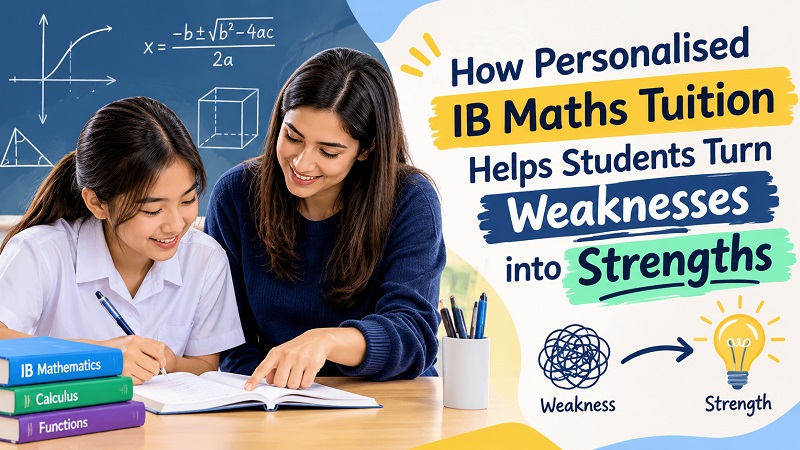
Every IB student knows the feeling. You understand the lesson in class, nod along with the worked example, and then freeze when the homework question looks slightly different. Weeks later, the same topic reappears in a mock exam and the marks slip away again.
IB Mathematics is demanding by design. Whether a student takes Analysis and Approaches (AA) or Applications and Interpretation (AI), at Standard Level (SL) or Higher Level (HL), the course rewards deep understanding, clear communication and strong problem-solving, not memorised formulas. That is exactly why generic revision often fails, and why personalised support makes such a difference.
At IB Maths Tutor, we have seen again and again that a weak topic is rarely a permanent weakness. It is usually a gap that nobody has diagnosed properly. In this guide, we explain how personalised IB Maths Tuition Singapore students can rely on turns those gaps into genuine strengths.
Quick Answer: How Does Personalised IB Maths Tuition Work?
Personalised IB Maths tuition works by first identifying exactly where a student loses marks and why, then building a tailored plan around those specific gaps. Instead of repeating the whole syllabus, a tutor targets foundational misunderstandings, teaches topic-specific strategies, trains exam technique and gives regular feedback. This approach rebuilds confidence and typically improves both understanding and grades far more efficiently than group revision or self-study alone.
Why Weaknesses in IB Maths Persist
Before fixing a weakness, it helps to understand where it comes from. In our experience with IB Maths Tuition Singapore learners, struggles usually trace back to a handful of root causes.
Hidden foundation gaps. IB topics build on one another. A student who finds calculus difficult may actually be struggling with algebraic manipulation or function notation from earlier years. Without addressing the root, every new topic feels harder.
Fast-paced classrooms. In a class of twenty or more, teachers must keep to the syllabus timeline. A student who needs an extra week on logarithms rarely gets it, and the gap quietly widens.
Memorising instead of understanding. Many students learn procedures without grasping why they work. This holds up until an exam question applies the concept in an unfamiliar context.
Weak exam habits. Losing marks to unclear working, missing units, poor calculator use or misreading command terms is incredibly common. These are teachable skills, but they are seldom taught explicitly.
Confidence and anxiety. After a few poor results, many students decide they are “just not a maths person.” That belief itself becomes a barrier to learning.
What “Personalised” Really Means in IB Maths Tuition
The word personalised is used loosely in education. At IB Maths Tutor, it means a learning experience shaped around one student rather than an average student.
1. A Diagnostic-First Approach
Everything begins with understanding the learner. A strong tutor reviews recent tests, mock papers, school reports and classwork, then asks the student to talk through their thinking on selected problems. This reveals the difference between a careless slip, a conceptual misunderstanding and a time-management issue. Each needs a different fix.
2. A Custom Learning Roadmap
Once gaps are mapped, the tutor builds a prioritised plan. A student aiming for a 7 in AA HL needs a different roadmap from a student working to secure a solid 5 in AI SL. The plan considers the student’s target grade, upcoming assessments, school schedule and the Internal Assessment (IA) timeline.
3. Teaching Matched to How the Student Learns
Some students need visual explanations with graphs and diagrams. Others learn best by working through examples step by step. Some benefit from technology, such as using a graphic display calculator (GDC) efficiently. One-to-one tuition allows the tutor to adapt the pace and style in real time, something a classroom simply cannot do.
4. Immediate, Specific Feedback
When a student makes an error in a personalised session, it is corrected on the spot, and the reasoning behind the mistake is explored. This prevents misconceptions from hardening into habits.
A Step-by-Step Process for Turning Weak Topics into Strong Ones
Here is the practical framework we use to convert a weakness into a strength.
Step 1: Identify the exact weak points. Rather than saying “I’m bad at functions,” we pinpoint the issue: perhaps composite functions, inverse functions or transformations of graphs.
Step 2: Rebuild the foundation. We revisit prerequisite skills, whether that is factorising, manipulating exponents or understanding gradient, until they feel automatic.
Step 3: Teach the concept, not just the method. Students learn why a technique works, so they can adapt it when the question changes.
Step 4: Practise with graduated difficulty. We begin with accessible problems to build momentum, then move to multi-step, exam-style questions that mirror IB paper structure.
Step 5: Train exam technique. This includes reading command terms such as “show that,” “hence” and “find,” presenting method marks clearly and using the GDC wisely on Paper 2.
Step 6: Review, reflect and revisit. Strong learners do not just correct errors; they keep an error log and revisit topics at spaced intervals so knowledge sticks.
This cycle turns a topic that once triggered dread into one the student can approach with a plan.
Tailored Support Across AA, AI, SL and HL
The IB offers different mathematics pathways, and each has its own demands.
Analysis and Approaches (AA) emphasises algebraic reasoning, proof and calculus. Students often need help with abstract thinking and rigorous mathematical communication.
Applications and Interpretation (AI) focuses on modelling, statistics and technology. Students often benefit from guidance on interpreting data, choosing the right model and using the GDC fluently.
Higher Level (HL) adds depth and breadth, with demanding topics and longer problem-solving questions. Standard Level (SL) requires solid fundamentals and consistent accuracy.
Personalised tuition respects these differences. A tutor who knows the syllabus inside out can focus on what actually appears in your course and assessments, not on generic maths content.
Strengthening the Internal Assessment (IA)
The IA is a significant part of the final grade, and many students find choosing a topic, structuring the exploration and demonstrating personal engagement surprisingly difficult. Personalised guidance helps students select a topic they genuinely care about, check the mathematical depth, structure their reasoning clearly and meet the assessment criteria. Importantly, a good tutor supports the student’s own thinking rather than doing the work for them, which protects academic integrity and builds real skill.
Building Confidence Alongside Competence
Academic improvement and confidence grow together. When students experience small, repeated wins in a one-to-one environment, their relationship with maths changes. They ask more questions, attempt harder problems and stop avoiding topics they once feared.
A supportive tutor also teaches practical habits: how to manage time under exam pressure, how to recover from a difficult question without losing momentum, and how to stay calm when a paper feels tough. These skills reach beyond maths into every part of IB life.
Why Students Choose IB Maths Tuition in Singapore
Singapore is home to a vibrant international school community, with many students following the IB Diploma Programme. The pressure to perform is high, schedules are busy, and university pathways, locally and overseas, often depend on strong IB results. That context makes targeted, efficient support valuable.
Students seeking IB Maths Tuition Singapore typically want three things: expert knowledge of the IB syllabus, flexibility around school commitments, and a tutor who explains concepts clearly. Many families also value the option of online lessons, which save travel time and make it easier to schedule sessions around CCAs, exams and deadlines.
How to Choose the Right IB Maths Tutor
Not every tutor is the right fit. When comparing options, look for:
- Proven IB experience. The tutor should understand the AA and AI syllabi, the assessment objectives and the marking approach.
- A diagnostic process. Be cautious of tutors who start teaching without first understanding your child’s gaps.
- Clear communication. The best tutors explain complex ideas simply and encourage questions.
- Structured progress tracking. You should see evidence of improvement through topic tests, past-paper results or feedback.
- Exam-focused strategy. Understanding is essential, but so is knowing how to earn marks under timed conditions.
- A good personal fit. Students learn best when they feel comfortable and respected.
Signs Your Child Could Benefit from Personalised IB Maths Tuition
- Grades are inconsistent or have dropped recently
- Homework takes much longer than it should
- Your child understands examples but struggles with new questions
- Careless errors keep costing marks
- Maths anxiety or avoidance is growing
- The IA feels overwhelming
- A target grade for university admission feels out of reach
If several of these sound familiar, early support can prevent small gaps from becoming major obstacles.
Frequently Asked Questions
How long does it take to see improvement with IB Maths tuition?
Many students notice greater clarity and confidence within a few weeks, while measurable grade improvement usually follows over one to three months of consistent practice. The timeline depends on the starting point, the target grade and how regularly the student practises between sessions.
Is one-to-one tuition better than group classes for IB Maths?
For addressing individual weaknesses, one-to-one tuition is generally more effective because the lesson is built entirely around the student’s needs. Group classes can suit students who only need light revision and enjoy collaborative learning.
Can tuition help with both AA and AI courses?
Yes. A qualified IB maths tutor adapts to the specific course, level and assessment requirements, including HL and SL pathways.
When should a student start IB Maths tuition?
The earlier, the better. Starting at the beginning of Year 1 of the Diploma helps prevent gaps from forming, but targeted support before mocks or final exams can also deliver strong results.
Does IB Maths tuition help with the Internal Assessment?
Yes. Tutors can guide topic selection, structure and criteria alignment while ensuring the work remains the student’s own.
Are online IB Maths tuition sessions effective?
Yes, when delivered with interactive tools such as digital whiteboards and shared worked solutions. Online sessions offer flexibility and are well suited to busy IB schedules in Singapore.
Conclusion: Weaknesses Are Starting Points, Not Limits
In IB Maths, a weak topic is not a verdict on a student’s ability. It is simply information about where support is needed. With accurate diagnosis, a tailored roadmap, concept-first teaching and consistent feedback, those weak areas can become the very topics a student feels most confident about.
That is the promise of personalised IB Maths Tuition Singapore families can count on. At IB Maths Tutor, our focus is on helping every student understand deeply, practise smartly and walk into the exam room prepared.