
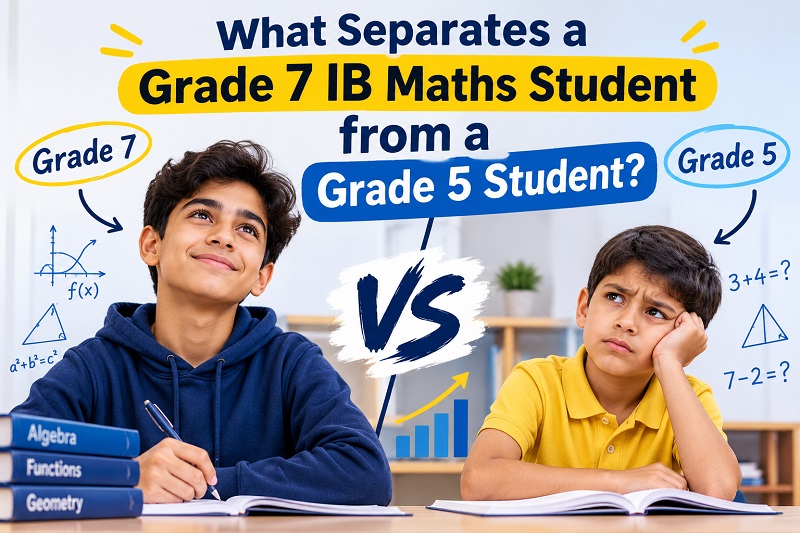
What Is the Difference Between a Grade 7 and a Grade 5 in IB Maths?
A Grade 7 IB Maths student does not necessarily know far more content than a Grade 5 student. The difference lies in accuracy, depth of understanding, problem-solving flexibility, exam technique and consistency. Grade 7 students apply concepts to unfamiliar problems, show clear method, avoid careless errors and review their mistakes systematically. Grade 5 students usually understand the basics but struggle with unfamiliar questions, lose marks through small errors and rely on memorising procedures.
Why This Question Matters
Every year, thousands of IB Diploma students ask the same thing: “I study hard, so why am I stuck on a 5?” The answer is rarely about intelligence or effort. In our experience at IB Maths Tutor, the gap between a 5 and a 7 is built from a handful of specific habits, and every one of them can be learned.
Whether you take Mathematics: Analysis and Approaches (AA) or Mathematics: Applications and Interpretation (AI), at Standard Level (SL) or Higher Level (HL), the same principles apply. Grade boundaries shift each exam session, but a 7 generally requires roughly the top 20 to 25 percent of available marks, while a 5 sits in the middle-to-upper range. That means the difference is often just 15 to 25 percentage points, which is closer than most students think.
Let’s break down exactly where those points are won and lost.
At a Glance: Grade 7 vs Grade 5 IB Maths Students
| Area | Grade 5 Student | Grade 7 Student |
|---|---|---|
| Understanding | Memorises formulas and steps | Understands why methods work |
| Problem-solving | Succeeds on familiar questions | Adapts to unfamiliar, multi-step problems |
| Accuracy | Frequent small errors | Checks work and avoids careless slips |
| Exam technique | Spends too long on hard questions | Manages time and secures method marks |
| Calculator use | Uses it for basic answers | Uses it strategically, including graphs and solvers |
| Mistakes | Fixes them and moves on | Logs patterns and eliminates them |
| Internal Assessment | Descriptive, safe topic | Personal, reflective, mathematically rich |
1. Grade 7 Students Understand the “Why”, Not Just the “How”
The most important difference is conceptual understanding. A Grade 5 student can often differentiate a function, solve a quadratic or apply a probability formula, but only when the question looks like one they have seen before.
A Grade 7 student knows why the derivative represents a rate of change, why a normal distribution behaves as it does, and why a particular method is valid. This matters because IB examiners deliberately write questions that disguise familiar ideas in unfamiliar contexts.
How to build it: After solving any problem, ask yourself, “Could I explain this to a classmate without my notes?” If not, you have memorised the method rather than understood it.
2. They Treat Unfamiliar Questions as Puzzles, Not Threats
IB Mathematics papers, especially the later questions in Paper 1 and Paper 2, are designed to stretch you. Grade 5 students often freeze when a question does not match a worked example. Grade 7 students stay calm and use a structured approach:
- Read the question twice and underline what is given and what is asked.
- Sketch a diagram or graph where possible.
- Identify the topic and list related formulas or ideas.
- Try a first step, even if the full route is unclear.
- Check whether the answer is reasonable.
This flexibility is trained through exposure. Grade 7 students typically complete far more past paper questions under realistic conditions, and they deliberately practise the hardest questions rather than avoiding them.
3. They Master Command Terms and Mark Scheme Language
IB questions use specific command terms such as “find”, “show that”, “hence”, “justify”, “determine” and “write down”. Each signals a different type of response.
- “Show that” requires every step of reasoning, because the answer is already given.
- “Hence” means you must use the previous part of the question.
- “Write down” usually means little or no working is needed.
Grade 5 students lose marks by skipping steps in “show that” questions or ignoring “hence”. Grade 7 students read mark schemes like a manual. They understand how method marks (M), accuracy marks (A) and reasoning marks (R) work, and they write solutions that earn every available mark, even when the final answer is wrong.
4. They Make Far Fewer Careless Errors
If you review a Grade 5 student’s paper, you often find that many lost marks were not due to missing knowledge. They came from:
- Sign errors
- Misreading the question
- Rounding too early
- Forgetting units or the required degree of accuracy (such as 3 significant figures)
- Copying numbers incorrectly
Grade 7 students build verification habits. They substitute answers back into equations, check that probabilities lie between 0 and 1, and confirm that a length is not negative. Over a full paper, these habits can be worth 5 to 10 percent, often the entire difference between a 5 and a 7.
5. They Use the GDC (Graphic Display Calculator) Strategically
In IB Maths, the calculator is a powerful tool, and many students use only a fraction of its capability. Grade 7 students are fluent with their GDC and use it to:
- Graph functions and find intersections, maxima, minima and roots
- Solve equations and systems quickly
- Perform statistical calculations such as regression, normal distribution and hypothesis tests
- Check their analytical answers
Importantly, they also know when not to use it. On Paper 1, where no calculator is allowed, they have strong algebra, trigonometry and calculus skills to fall back on. A Grade 5 student is often strong in one of these areas but weak in the other, which creates inconsistency across papers.
6. They Manage Time Like a Strategy, Not an Afterthought
Time management is a quiet separator. Grade 5 students often spend 15 minutes on a single hard question early in the paper, then rush the remaining questions and lose easy marks.
Grade 7 students follow a plan:
- Answer the accessible questions first to secure marks and build confidence.
- Move on after 2 to 3 minutes if completely stuck, marking the question to revisit.
- Leave time at the end for checking, typically 5 to 10 minutes.
They practise this repeatedly with timed past papers, so the pacing feels automatic on exam day.
7. They Learn From Their Mistakes Systematically
This is perhaps the most underrated habit. Many students complete a past paper, check the score, glance at the mark scheme and move on. Grade 7 students treat every error as data.
They keep an error log with columns such as:
- Question and topic
- What went wrong (concept gap, careless error, time pressure, misread)
- The correct method
- A similar question to retry in one week
After a few weeks, patterns emerge. A student might discover that 60 percent of their lost marks come from algebraic slips, not calculus concepts. That insight allows targeted practice instead of random revision.
8. They Secure Strong Marks in the Internal Assessment (IA)
The Mathematics Exploration (IA) is worth 20 percent of your final grade in both SL and HL, and it is where many students either secure or lose their Grade 7.
Grade 5 IAs tend to:
- Choose a safe topic with limited mathematical depth
- Describe calculations rather than reflect on them
- Show little personal engagement
- Use technology without explaining or interpreting results
Grade 7 IAs typically:
- Choose a topic that genuinely interests the student
- Demonstrate sophisticated, appropriate mathematics
- Include clear reflection, limitations and evaluation of results
- Communicate in a logical, well-structured way
Starting the IA early and getting feedback on drafts makes an enormous difference.
9. They Practise Consistently, Not in Last-Minute Bursts
Mathematics is cumulative. Grade 5 students often cram in the weeks before exams, which works for memorisation but not for deep skill-building. Grade 7 students practise little and often, usually 30 to 60 minutes a day, using techniques such as:
- Spaced repetition: revisiting topics every few weeks
- Interleaving: mixing topics rather than practising one at a time
- Active recall: attempting questions without looking at notes first
These methods are strongly supported by learning research and make knowledge durable under exam pressure.
10. They Ask for Help Early
Grade 7 students rarely wait until they are hopelessly behind. They ask their teacher, a tutor or a study group as soon as a concept feels shaky. Quick, targeted feedback prevents small misunderstandings from becoming large gaps, especially in topics that build on one another, such as functions, calculus and statistics.
A Practical 6-Week Plan to Move From a 5 Toward a 7
Weeks 1 to 2: Diagnose. Complete a full timed past paper. Build your error log. Identify your three weakest topics.
Weeks 3 to 4: Repair. Rebuild understanding in your weak topics using textbooks, videos or tutoring, then practise exam-style questions until you can complete them reliably.
Week 5: Train technique. Practise command terms, mark scheme language and GDC skills. Do timed sections of papers.
Week 6: Simulate. Complete two full papers under exam conditions, review them thoroughly and refine your time strategy.
Repeat the cycle, and your grade will follow.
Frequently Asked Questions
How many marks do you need for a Grade 7 in IB Maths?
Boundaries change every session and differ between AA, AI, SL and HL. A Grade 7 typically requires roughly 75 to 80 percent or more of total marks, while a Grade 5 usually falls in the 55 to 65 percent range. Always check the latest official boundaries published by the IB.
Is it realistic to move from a Grade 5 to a Grade 7?
Yes, with focused effort over several months. Because the gap is often only 15 to 25 percentage points, reducing careless errors, improving exam technique and strengthening weak topics can deliver a two-grade jump.
What is the biggest reason students get a Grade 5 instead of a 7?
The most common reasons are lost marks from careless errors, difficulty with unfamiliar problem types and poor time management. Content knowledge is rarely the main issue.
Should I choose AA or AI to get a higher grade?
Choose the course that matches your strengths and university plans. AA suits students who enjoy algebra, calculus and proof, while AI suits those who prefer modelling, statistics and technology. Neither is “easier”, and both can lead to a 7.
Can an IB Maths tutor help me reach a Grade 7?
A qualified tutor can diagnose your gaps quickly, teach exam technique, review your IA and provide personalised practice. This targeted support is often what helps students break through a plateau.
Key Takeaways
- The gap between a 7 and a 5 is about habits, not talent.
- Grade 7 students understand concepts deeply, manage time wisely and minimise careless errors.
- A strong IA and a well-used GDC protect marks across the course.
- An error log and consistent practice turn weaknesses into strengths.
- Early, expert support accelerates progress.
Ready to Aim for a Grade 7?
At IB Maths Tutor, we help students in AA and AI, at SL and HL, move beyond the plateau with personalised lessons, exam-focused practice, IA guidance and proven strategies built around the IB mark scheme. If you are ready to turn a Grade 5 into a Grade 7, get in touch today to book a free consultation and start your journey.